News in Picture

Related Posts Plugin for WordPress, Blogger...
Showing posts with label Bomb. Show all posts

Saturday, April 12, 2014

Improved RGP Designs are Challenge Bar Armor Manufacturers

Since their introduction in operational service in 1961 the Rocket Propelled Grenade Mk 7 (RPG-7) over nine million RPGs have been produced, and hundreds of thousands fired in combat in war zones around the world.

Although RPG-7s proved their battle effectiveness in every conflict since the 1970s, NATO and coalition forces were surprised and ill prepared when they first encountered RPGs in Iraq in 2004. At the time these weapons were used primarily against heavy armored fighting vehicles, while Improvised Explosive Devices (IED) were directed at the less protected or unprotected tactical vehicles.
RPG-7, launcher and rocket
Realizing the gravity of this evolving threat, coalition forces began to protect their armored vehicles with add-on armor solutions designed to defeat RPGs. Since the PG-7VL High Explosive Anti-Tank (HEAT) warhead penetrates over 500 mm of steel armor with its shaped charge hitting the target, the only affordable solution was to eliminate the threat from hitting its target. Reactive add-on armor was an effective countermeasure applied to the heavier armored vehicles. Less protected vehicles were encapsulated with bar-armor cages.
The bar-armor cage is preventing RPGs from detonating theirshaped charge close to the vehicle’s armor, thus penetrating the armor and causing severe internal damage. The cages are assembled from steel or aluminum bars. Bars are spaced in a form that would ‘trap’ the incoming warhead.
The operating mechanism of bar armor is simple and effective. As the RPG flies through the cage the warhead is smashed between two bars, deforming the conductive layers that form the ogive (cone) holding the piezoelectric precursor and covering the explosive charge. As the external liner bends in, it would touch the inner liner, causing a short circuit that disrupts the explosive triggering chain.
This image depicts the classical bar armor RPG-7 defeat mechanism.
The first-generation bar armor made of steel or aluminum were relatively heavy, weighing about 20-30 kg/square meter. Follow-on solutions that included counter-RPG net came in much lighter weight but suffered from the same lower efficiency with the same neutralization mechanism. Although the method provided reasonable protection, it did not provide conclusive results. In fact, it is likely that every second RPGs would ‘slip away’ and defeat the bar armor protection, either with full hollow charge penetration of the shaped charge, or while having a secondary explosion and piercing the platform hull (without forming the plasma jet). Such risk is especially evident on the less protected parts of the armored vehicles. Ceilings are often composed of thin armor and are rarely protected by bar armor cages or nets; the windshield and side windows are also vulnerable to secondary explosions.
Hence, this RPG protection is referred to as ‘statistical protection’, since the efficiency of the armor is not conclusive, but dependent on where and how each RPG will hit. Typical effectiveness of bar armor in defeating various RPG-7 warheads depends on the type of warhead (different manufacturers produce HEAT warhead diameters from 70 to 90mm). Hence, statistical protection ranges from 50 up to 70 percent for first and second generation.
In recent years, new types of bar armor, net protection systems and various hybrid systems were introduced and applied to most of the vehicles deployed in Afghanistan. More recently, French vehicles operating in Mali and elsewhere in Africa are also equipped with counter-RPG protection, with high level of performance, attributed to the latest, most advanced non-bar type solutions.
The reactive armor, first introduced by the Israeli army in the first Lebanon war in 1982 proved highly effective against RPGs and anti-tank missiles, driving the development of tandem warheads. The RPG-7 received such a warhead, designated PG-7VR in 1988. These warheads were first employed against US armor in Iraq in 2004.
Insurgents, becoming aware of the bar armor and its weaknesses, have employed several methods to defeat bar armor, among them rudimentary extensions of the impact sensor (piezoelectric trigger located at the tip of the round). These extensions would cause the fuse to activate before the ogive is smashed by the armor, thus activating the shaped charge ahead of the armor.
While passive RPG armor technology is improving, particularly by reducing weight and improving the theoretical statistical protection, more progress on the side of the RPGs would render the systems relying on the ‘smashing‘ totally ineffective.
In recent years, RPG manufacturers have also introduced enhancements to overcome common bar armor techniques and nets technology. “RPG manufacturers are applying protective layers at the base of the cone, thus avoiding potential short-circuits caused by deformation,” an armor expert told Defense-Update. Challenged by these improved RPGs, armor designers are now seeking to find alternative solutions by employing mechanisms that would guarantee the defeat of the warhead regardless of the type of RPG they are encountering.
According to our sources, since 2012 some RPG manufacturers have added a durable plastic sheet between the two conductive layers forming the ogive. This sheet prevents the two layers from short circuiting in case they are smashed, thus rendering the ogive operational even after it has hit a bar or passed through a net. The damaged RPG will continue flying and will hit the vehicle, initiating the shaped charge on contact. “In fact, as it will hit at an angle, the behind armor effect could be increased, as the spall is distributed at a larger lethal cone, hitting more of the vehicle occupants,” the expert warned. “We are going to see more and more of these in the battlefield.”
»»  READMORE...

Monday, July 8, 2013

Hirtenberger - Mortar Systems and Ammunition


Founded back in 1860, today Hirtenberger Defence Systems offers top quality and precision-made ammunition for a range of mortars, tanks and artillery weapon systems. Sustained research, development and continuous search for improvement has made the company known throughout the world: the name Hirtenberger is a guarantee for quality and precision, certified according to ISO 9001:2000.

MORTAR SYSTEMS

A complete range of mortar systems in 60mm, 81mm (82mm) and 120mm calibre, featuring high firing power, long range, high accuracy and maximum reliability, is manufactured by Hirtenberger.

60MM COMMANDO MORTAR

The Hirtenberger 60mm commando mortar is an easy handling and highly accurate weapon designed for special missions. It displays extraordinary advantages in difficult terrain, such as mountains, jungle and desert, as well as urban areas. The unique handgrip / trigger system allows firing in flat trajectories.

M6-640, M6-895 AND M6-1000 60MM MORTARS

This conventional 60mm mortar is specially designed as a weapon for indirect fire support for infantry and paratroopers. It can be delivered in a standard barrel and a long range model.

M8-1165 AND M8-1365 81MM MORTARS

Developed for the Austrian Army, these mortars not only meet the highest tactical and logistical demands, they will also operate under extremely different topographical conditions. They are available in a standard and long range variety.

M12-1385 AND M12-1535 MORTARS 120MM

Also developed for the Austrian Army, these 120mm mortars meet the highest tactical and logistical demands and operate under extremely difficult conditions. Thanks to their high firing capacities, high accuracy and quick and easy operation these systems can be considered to be amongst the finest in their class.

MORTAR BOMBS

Hirtenberger mortar bombs are of the highest combat-effectiveness and provide maximum safety. Perfect operation even in adverse environments (such as deserts, swamps and jungles), high range, top precision and improved storage capability are just the major advantages of these state-of-the-art technical constructions.
The mortar bombs are produced in 60mm, 81mm (82mm) and 120mm calibres. The types available are HE, SMK-WP, SMK-TTC, Target Practice (TP), ILL-VIS and ILL-IR.
ILL-IR rounds are considerably enhancing night-fighting capability, providing a major tactical advantage on the battlefield.

105MM TANK AMMUNITION

Hirtenberger provides 105mm tank gun ammunition for L/7, CN-105-F1, RH-105, M68 and equivalent weapon NATO 105mm tank gun systems, regardless of whether these guns are mounted on Leopard 1, Centurion, Chieftain, Centauro, AMX-30, M60, M48A5 or Challenger tanks.
For the M105mm M57 tank gun for Kürassier and AMX-13 tanks, HE, HESH, HESH practice and APFSDS-T types are available, as well as other types on request.

105MM HOWITZER AMMUNITION

105mm howitzer ammunition tailored to the needs of customers' artillery weapon systems is also produced by Hirtenberger. 105mm howitzer ammunition is available as HE, SMK-WP and SMK-TTC types; blanks are available too.

155MM M107I HOWITZER AMMUNITION

Hirtenberger has developed an M107 type improved round (M107I), which eliminates all disadvantages of the classic M107 round, but features the same outer design and carries the same payload of explosives. By introducing a new metallurgical composition, the number of fragments is increased almost five-fold compared to a conventional M107 round.
Furthermore, the M107I can be fired with charge M203 (zone 9), enabling the round to achieve an additional 20% increase in range applicable to all 155mm howitzers in calibres 33, 39, 42 and 52.

155MM BASE BLEED AND BOAT TAIL ERFB PROJECTILES

Customers who do not wish to compromise range capabilities can further opt for ERFB projectiles, either in Base Bleed (BB) or Boat Tail (BT) versions. Smoke rounds and inert practice rounds with identical ballistic match complete the ERFB projectile family.


Montage image showing mortar being loadedHirtenberger Defence Systems offers top quality and precision-made ammunition for a range of mortars, tanks and artillery weapon systems.
60mm commando mortar being firedHirtenberger 60mm commando mortar.
M6 60 mm bipod mortar being aimedM6 60 mm bipod mortar.
Hirtenberger 81mm mortar being loaded Hirtenberger 81mm mortar.
A range of martar from HirtenbergerA wide range of different mortars in 60mm, 81mm and 120mm calibre can be offered.
»»  READMORE...

Wednesday, June 26, 2013

BUMN INI BISA BUAT BOM F16 DAN SUKHOI, HINGGA ROKET ANTI TANK


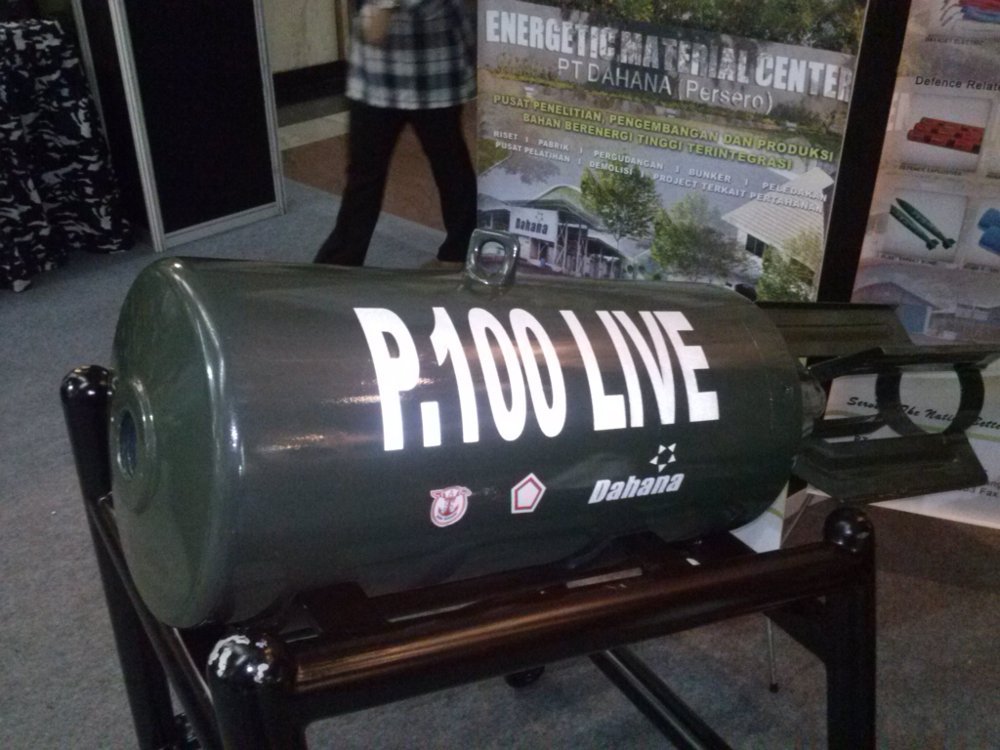
http://images.detik.com/content/2013/06/24/1036/bbm.jpgJakarta - PT Dahana (Persero) memiliki kemampuan membuat bahan peledak untuk keperluan militer dan sipil. Salah satu produk terbarunya untuk versi militer adalah bom berdaya ledak tinggi untuk pesawat tempur F16 dan Sukhoi yang dimiliki TNI AU.

"Buat bom, untuk pematik. Bomnya P100 untuk Sukhoi dan F16," ucap Public Relations Dahana Juli Jajuli kepadadetikFinance di sela pameran Harteknas di Kantor BPPT Thamrin, Jakarta, Senin (24/6/2013).

Menggandeng perusahaan swasta lokal yakni Sari Bahari, BUMN strategis ini siap memasok kebutuhan bom berdaya ledak rendah hingga tinggi. Produksi bom ini, nantinya dapat mengurangi ketergantungan terhadap impor. "Kalau pesawat Sukhoi kan tergantung Rusia, akhirnya dirancang supaya nggak tergangtung," tambahnya.

Juli menjelaskan, pihaknya juga tengah mengembangkan sebuah peledak untuk kebutuhan roket anti tank. Menurutnya, bahan peledak ini sebelumnya hanya digunakan untuk keperluan pengeboran perusahaan minyak dan gas.

"Sebelumnya diproduksi untuk oil and gas. Nanti akan dikembangkan untuk tank. Ini bisa melubangi tank," tegasnya.(feb/dnl)


  ● detikFinance 
»»  READMORE...

Thursday, May 23, 2013

Dahana Kembangkan Handak Biodegradable dan propelan

20130401
Menjadi perusahaan bahan peledak yang berwawasan lingkungan. Itulah satu slogan PT Dahana (Persero) yang tak hanya fokus pada kepuasan konsumen, namun menjadikan perusahaan senantiasa peduli dengan lingkungan dalam setiap aktivitas bisnisnya.
Dalam usahanya menjadi perusahaan yang berkonsep hijau dari mulai proses produksi hingga produknya sampai di tangan konsumen, perusahaan yang berkantor di Menara MTH lantai 17 ini, kini sedang mengembangkan bahan peledak  biodegradable, yaitu bahan peledak (handak) model baru dengan konsep terbarukan.
Diungkapkan Yusep Nugraha, Special Project Coordinator PT Dahana (Persero), saat ini sektor  eksplorasi migas sudah ada yang menggunakan handak biodegradable. Konsumen migas memilih handak biodegradable dengan pertimbangan bahwa umur aktif handak jenis ini bisa ditentukan, sehingga konsumen bisa memastikan penanganan bahan peledak tersebut secara pasti dan tepat waktu, baik handak itu digunakan saat eksplorasi migas di lapangan maupun saat disimpan di gudang.
Dahana, bersama dengan Teknik Kimia ITB, mengembangkan bahan peledak jenis itu berbasis produk Dayagel yang saat ini sudah diproduksi oleh Dahana. Untuk memenuhi kebutuhan eksplorasi migas tersebut, Dahana berencana memproduksi massal bahan peledak biodegradable untuk melengkapi variasi produk handak seismik.  “Diharapkan handak seismik biodegradable ini juga limbahnya aman bagi lingkungan dan bisa jadi pupuk, karena setelah umur aktifnya tercapai langsung terurai secara biologis,” pungkas Yusep.
Seiring dengan motto “Serving the nation better”, Dahana juga telah menyiapkan fasilitas dan infrastruktur untuk dipakai melayani kebutuhan negara dalam bidang militer. Direncanakan dalam    waktu dekat pemerintah bisa merealisasikan pembangunan berbagai pabrik propelan secara bertahap di Energetic  Material Center, Subang, untuk kemudian dibantu pengoperasiannya oleh Dahana. Diharapkan dengan adanya pabrik propelan, kemandirian Indonesia dalam memasok kebutuhan propelan yang digunakan dalam alat utama sistem senjata bisa terpenuhi. Selain itu, produk propelan tersebut  juga  bisa diekspor ke negara lain apabila ternyata pasokannya melebihi kebutuhan dalam negeri (IDR)
»»  READMORE...

Sunday, May 5, 2013

USAF Readies Massive Ordnance Penetrator for Showdown in Iran


Weapon specialists look on as a mock up of the Massive Ordnance Penetrator sits in bomb bay of the B-2 weapons load trainer Dec. 18 at Whitman Air Force Base, Mo. (U.S. Air Force photo)
The US has enhanced its biggest bunker buster bomb specifically to enable the destruction of Iran’s underground Fordow uranium enrichment plant near the city of Qom. 20 such bombs – the biggest and heaviest bomb in the US arsenal, will be delivered this year, following the completion of upgrades and testing. The redesigned Massive Ordnance Penetrator (MOP) GBU-57A-B is now adapted for operations in heavily contested environment, where it will require to operate against Iran’s most protected nuclear sites. Defense-Updatereports.
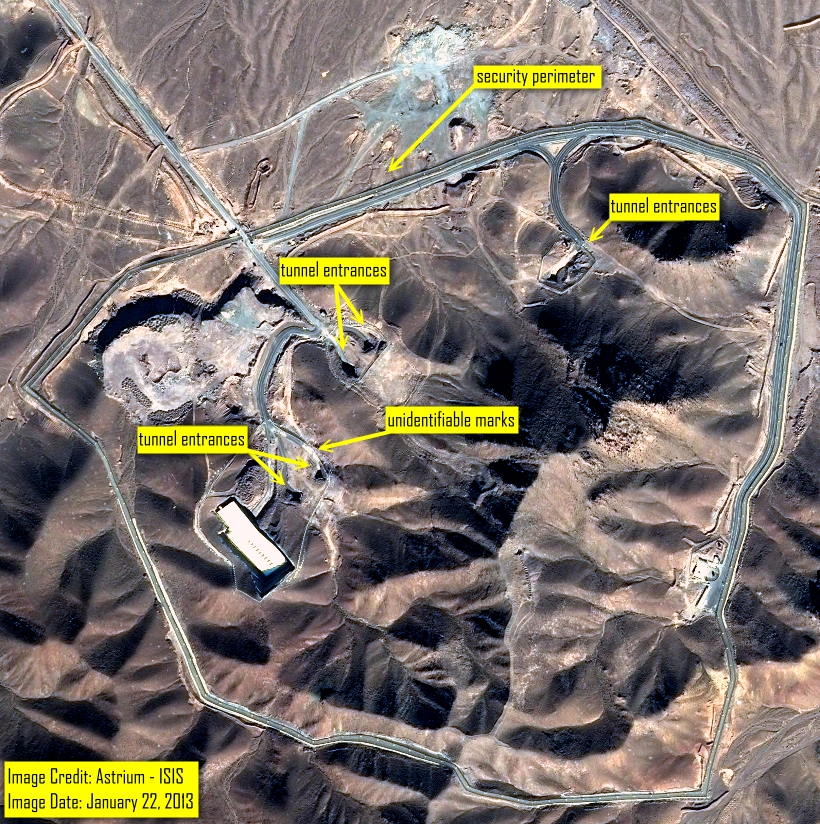
The target: Iranian uranium enrichment deeply burried underground site at Fordow. Photo:
The target: Iranian uranium enrichment deeply burried underground site at Fordow. Photo: Astrium – ISIS
The White House see the development of the weapon as critical to convincing Israel that the U.S. has the ability to prevent Iran from getting a nuclear bomb if diplomacy fails, and also that Israel’s military can’t do that on its own. According to an article published by the Wall Street Journal, several times in recent weeks, American officials, seeking to demonstrate U.S. capabilities, showed Israeli military and civilian leaders secret Air Force video of an earlier version of the bomb hitting its target in high-altitude testing, and outlined the development made recently to improve the weapon. In the video, the weapon can be seen penetrating the ground within inches of its target, followed by a large underground detonation, according to people who have seen the footage.
According to the Wall Street Journal, the improvements are meant to address U.S. and Israeli concerns that Fordow couldn’t be destroyed from the air. Overcoming that obstacle could also give the West more leverage in diplomatic efforts to convince Iran to curtail its nuclear program. The upgraded MOP was enhanced almost exclusively to hit the Fordow Enrichment Plant, Iran’s largest nuclear facility, located under a mountain near the city of Qom. It’s buried so deep that, according to the Wall Street Journal, experts believe it would take several MOPs to destroy it, with one creating a crater and the rest using the improved guidance system to dive in after it and destroy the complex. The MOP was upgraded because officials didn’t believe the previous version could penetrate Fordow. The bombs could also be used to strike North Korea’s less protected nuclear bunkers. The message the MOP sends is clear: While the United States almost certainly won’t use nuclear weapons, it still has a pretty formidable arsenal capable of taking out even Iran’s most secure facilities, the newspaper added. “We are committed to trying to resolve concerns about Iran’s nuclear program diplomatically,” Caitlin Hayden, White House National Security Council spokesperson, told the Journal. “But, as President Obama has made clear: The U.S. will not allow Iran to acquire a nuclear weapon. The onus is on Iran and it knows that time is not unlimited.”
The GBU-57A-B weighs 16.6 tonnes (30,000-pound) most of the weight is its steel casing, enabling the 6.24 meter (20 foot) bomb bomb to penetrate through 18 meters (60 foot) of reinforced concrete. Only two platforms currently operational with the US Air Force can carry such a heavy weapon – the B-2 Spirit stealth bomber and old B-52H. The Air Force is managing and funding the program, with support from Defense Threat Reduction Agency (DTRA). The project began in 2004 as a proof of technology demonstration, viewing a conventional weapon that could support the President Bush Nuclear Policy Review, with emphasis on providing conventional weapon options to national commands, thus reduce the nation’s dependence on nuclear weapons as a deterrent in the national security strategy. Early tests of MOP were conducted by DTRA under the MOP Technology Demonstration effort. These tests began in 2004 with DTRA partnering with the Air Force Research Laboratory. DTRA conducted flight tests from 2008 to 2010.
In February 2010, the DTRA MOP Technology Demonstration transitioned to the Air Force as a Quick Reaction Capability Program demonstrating an operational capability to attack hard and deeply-buried facilities. Air Force officials long stated that they had a long-standing requirement for this capability. In 2009 Boeing was awarded the contracts to complete MOP/Aircraft integration and produce 20 weapons. In recent months the weapon went through the final cycle of upgrades, which adjusted fuses to maximize its burrowing power, adjusted specifically to withstand impact with layers of granite and steel that encase the nuclear facility. Other upgrades address the guidance systems to improve the precision of its inertial navigation system and deny the effect of GPS jamming or other electronic countermeasures. According to the US Air Force, flight tests have been successfully conducted at White Sands Missile Range, New Mexico.
According to Air Force sources, MOP integration activities for initial weapon delivery are also complete. Final system refinement, design and test was completed in 2012 with additional weapon deliveries planned in 2013 but according to sources, the upgraded MOP hasn’t been dropped from a plane yet. Officials said they believe the enhanced bomb would be even more effective against North Korea’s nuclear bunkers, which the U.S. thinks aren’t as heavily fortified as Iran’s.
Weapon specialists gather in front of a mock up of the Massive Ordnance Penetrator and the B-2 weapons load trainer Dec. 18 at Whitman Air Force Base, Mo. Photo: USAF
Weapon specialists gather in front of a mock up of the Massive Ordnance Penetrator (MOP) and the B-2 weapons load trainer Dec. 18 at Whitman Air Force Base, Mo. In 2012 members of the MOP program team received the 16th annual William J. Perry Award in recognition of their contributions to precision strike systems. The program team, consisting of representatives from the Air Force, Defense Threat Reduction Agency and in partnership with The Boeing Company, was honored for their technical excellence in the development, testing and fielding of the MOP, one of the Secretary of Defense’s number one weapons programs, according to the award citation. Photo: USAF

Source: Defense-Update
»»  READMORE...