News in Picture

Related Posts Plugin for WordPress, Blogger...

Sunday, May 5, 2013

USAF Readies Massive Ordnance Penetrator for Showdown in Iran


Weapon specialists look on as a mock up of the Massive Ordnance Penetrator sits in bomb bay of the B-2 weapons load trainer Dec. 18 at Whitman Air Force Base, Mo. (U.S. Air Force photo)
The US has enhanced its biggest bunker buster bomb specifically to enable the destruction of Iran’s underground Fordow uranium enrichment plant near the city of Qom. 20 such bombs – the biggest and heaviest bomb in the US arsenal, will be delivered this year, following the completion of upgrades and testing. The redesigned Massive Ordnance Penetrator (MOP) GBU-57A-B is now adapted for operations in heavily contested environment, where it will require to operate against Iran’s most protected nuclear sites. Defense-Updatereports.
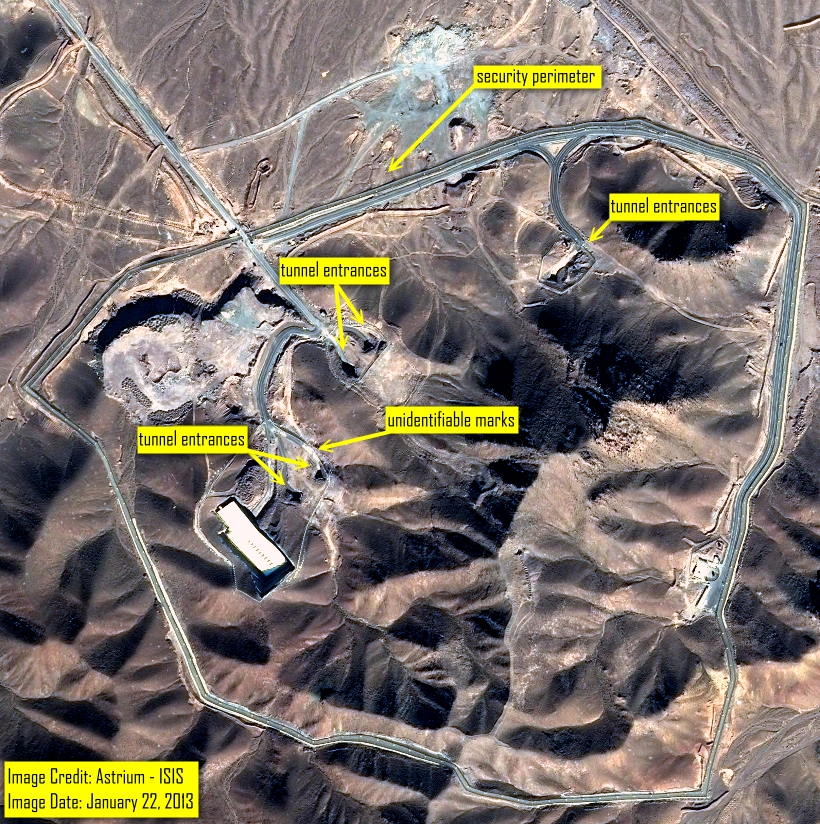
The target: Iranian uranium enrichment deeply burried underground site at Fordow. Photo:
The target: Iranian uranium enrichment deeply burried underground site at Fordow. Photo: Astrium – ISIS
The White House see the development of the weapon as critical to convincing Israel that the U.S. has the ability to prevent Iran from getting a nuclear bomb if diplomacy fails, and also that Israel’s military can’t do that on its own. According to an article published by the Wall Street Journal, several times in recent weeks, American officials, seeking to demonstrate U.S. capabilities, showed Israeli military and civilian leaders secret Air Force video of an earlier version of the bomb hitting its target in high-altitude testing, and outlined the development made recently to improve the weapon. In the video, the weapon can be seen penetrating the ground within inches of its target, followed by a large underground detonation, according to people who have seen the footage.
According to the Wall Street Journal, the improvements are meant to address U.S. and Israeli concerns that Fordow couldn’t be destroyed from the air. Overcoming that obstacle could also give the West more leverage in diplomatic efforts to convince Iran to curtail its nuclear program. The upgraded MOP was enhanced almost exclusively to hit the Fordow Enrichment Plant, Iran’s largest nuclear facility, located under a mountain near the city of Qom. It’s buried so deep that, according to the Wall Street Journal, experts believe it would take several MOPs to destroy it, with one creating a crater and the rest using the improved guidance system to dive in after it and destroy the complex. The MOP was upgraded because officials didn’t believe the previous version could penetrate Fordow. The bombs could also be used to strike North Korea’s less protected nuclear bunkers. The message the MOP sends is clear: While the United States almost certainly won’t use nuclear weapons, it still has a pretty formidable arsenal capable of taking out even Iran’s most secure facilities, the newspaper added. “We are committed to trying to resolve concerns about Iran’s nuclear program diplomatically,” Caitlin Hayden, White House National Security Council spokesperson, told the Journal. “But, as President Obama has made clear: The U.S. will not allow Iran to acquire a nuclear weapon. The onus is on Iran and it knows that time is not unlimited.”
The GBU-57A-B weighs 16.6 tonnes (30,000-pound) most of the weight is its steel casing, enabling the 6.24 meter (20 foot) bomb bomb to penetrate through 18 meters (60 foot) of reinforced concrete. Only two platforms currently operational with the US Air Force can carry such a heavy weapon – the B-2 Spirit stealth bomber and old B-52H. The Air Force is managing and funding the program, with support from Defense Threat Reduction Agency (DTRA). The project began in 2004 as a proof of technology demonstration, viewing a conventional weapon that could support the President Bush Nuclear Policy Review, with emphasis on providing conventional weapon options to national commands, thus reduce the nation’s dependence on nuclear weapons as a deterrent in the national security strategy. Early tests of MOP were conducted by DTRA under the MOP Technology Demonstration effort. These tests began in 2004 with DTRA partnering with the Air Force Research Laboratory. DTRA conducted flight tests from 2008 to 2010.
In February 2010, the DTRA MOP Technology Demonstration transitioned to the Air Force as a Quick Reaction Capability Program demonstrating an operational capability to attack hard and deeply-buried facilities. Air Force officials long stated that they had a long-standing requirement for this capability. In 2009 Boeing was awarded the contracts to complete MOP/Aircraft integration and produce 20 weapons. In recent months the weapon went through the final cycle of upgrades, which adjusted fuses to maximize its burrowing power, adjusted specifically to withstand impact with layers of granite and steel that encase the nuclear facility. Other upgrades address the guidance systems to improve the precision of its inertial navigation system and deny the effect of GPS jamming or other electronic countermeasures. According to the US Air Force, flight tests have been successfully conducted at White Sands Missile Range, New Mexico.
According to Air Force sources, MOP integration activities for initial weapon delivery are also complete. Final system refinement, design and test was completed in 2012 with additional weapon deliveries planned in 2013 but according to sources, the upgraded MOP hasn’t been dropped from a plane yet. Officials said they believe the enhanced bomb would be even more effective against North Korea’s nuclear bunkers, which the U.S. thinks aren’t as heavily fortified as Iran’s.
Weapon specialists gather in front of a mock up of the Massive Ordnance Penetrator and the B-2 weapons load trainer Dec. 18 at Whitman Air Force Base, Mo. Photo: USAF
Weapon specialists gather in front of a mock up of the Massive Ordnance Penetrator (MOP) and the B-2 weapons load trainer Dec. 18 at Whitman Air Force Base, Mo. In 2012 members of the MOP program team received the 16th annual William J. Perry Award in recognition of their contributions to precision strike systems. The program team, consisting of representatives from the Air Force, Defense Threat Reduction Agency and in partnership with The Boeing Company, was honored for their technical excellence in the development, testing and fielding of the MOP, one of the Secretary of Defense’s number one weapons programs, according to the award citation. Photo: USAF

Source: Defense-Update
»»  READMORE...

Stasiun Luar Angkasa Ditembus Meteor Sekecil Peluru


Kecepatan benda ini mencapai 35.000 kilometer per jam.

ddd
Astronot-astronot yang bekerja di International Space Station
Astronot-astronot yang bekerja di International Space Station(nasa.gov)
VIVAnews - Stasiun Luar Angkasa Internasional diterjang meteor kecil berukuran seperti peluru. Meteor ini bergerak dengan kecepatan tinggi sehingga menembus panel surya stasiun luar angkasa tersebut.

Diberitakan Daily Mail, Jumat 3 Mei 2013, adalah astronot dan Komandan Stasiun Luar Angkasa Internasional Chris Hadfield yang pertama kali menyadari hal ini. Dia melihat sebuah lubang kecil berdiameter 0,6 cm di salah satu panel surya.

Dia meyakini lubang ini disebabkan oleh batu kecil yang disebut micrometeorit yang telah menghantam pos luar angkasa dalam 14 tahun terakhir.

Beruntung, meteor itu tidak menghantam lambung stasiun. Jika sampai kejadian, akan fatal akibatnya. Saat ini, tim dari NASA tengah menambal lubang tersebut. Meteor mikro sulit dideteksi sehingga para astronot di antariksa harus ekstra hati-hati.

Meteor kecil seperti yang menghantam stasiun luar angkasa ini adalah satu dari 5.500 ton sampah luar angkasa di luar orbit bumi. Selain meteor, sampah luar angkasa bisa berupa bangkai satelit, roket dan batu. Kecepatan terbang sampah ini bisa mencapai 35 ribu kilometer per jam. (kd)

»»  READMORE...

Pesawat Ruang Angkasa Ini Siap Dampingi Matahari


Pesawat ini memanfaatkan cahaya Matahari sebagai bahan bakar.


Sunjammer


Badan antariksa Inggris, UK  space Agency, bekerja sama dengan NASA mengembangkan pesawat ruang angkasa yang siap mendekati Matahari.

Dilansir Telegraph, Sabtu 4 Mei 2013, pesawat yang bernama Sunjammer ini akan menggunakan 13.000 persegi kaki setara 1.207 meter persegi layar surya (solar soil) untuk mendorong pesawat hampir 2 juta mil setara 3,2 juta km menuju Matahari. 

Layar surya merupakan jenis pesawat ruang angkasa yang memanfaatkan cahaya Matahari sebagai bahan bakar. Beda dengan pesawat konvensional, menggunakan mesin pembakaran internal.

Layar itu akan membantu mengendalikan pesawat dalam posisi stabil di orbit Matahari. Sunjammer nantinya juga diposisikan sebagai observatorium Matahari.

Instrumen sensitif dalam Sunjammer itu juga membantu ilmuwan sebagai peringatan dini terjadinya badai Matahari. Untuk diketahui, badai Matahari dapat merusak satelit dan jaringan listrik di Bumi.

Tujuan misi ini, menurut Jonathan Eastwood, dosen fisika di Imperial College London yang merupakan salah satu ilmuwan pada proyek ini, yaitu menunjukkan penggunaan layar Matahari sebagai sumber energi untuk mengendalikan pesawat dalam sebuah misi panjang.

"Pesawat ruang angkasa yang kami gunakan saat ini untuk memantau angin Matahari hanya 1,5 juta km dari Bumi. Untuk mendekati Matahari, perlu jenis baru bahan bakar agar menahan pesawat ruang angkasa terhadap tarikan gravitasi Matahari," ujar Eastwood. 

Atas dasar itulah, menurut dia, layar surya diperlukan. 

Kurangi problem antariksa

NASA telah mengembangkan bahan yang sangat ringan untuk layar besar pesawat, yang dikenal sebagai Solar Sail Demonstran. 

Prinsip kerja layar itu sama halnya seperti perahu layar tradisional, layar pesawat akan menggunakan aliran tekanan sinar Matahari dan angin Matahari untuk menstabilkan jalan pesawat pada posisinya.

Layar ini akan difungsikan setelah pesawat berada di luar atmosfer Bumi. 

Penggunaan layar besar ini juga menjadi cara lain untuk mengurangi 8.000 sampah antariksa yang mengorbit. Bahkan, terdapat pengajuan, layar besar ini dapat digunakan untuk mengalihkan asteroid yang akan menabrak Bumi.

Misi Sunjammer akan dilakukan pada 2014. Nama Sunjammer berasal dari judul cerita pendek yang ditulis oleh pengarang Inggris, Arthur C. Clarke. Ia menulis tentang layar surya.

Ada beberapa misi lanjutan dari badan antariksa negara maju untuk mendalami Bumi. Misalnya misi Solar Orbiter yang akan melakukan perjalanan pada 2017. Solar Orbiter akan semakin dekat dengan Matahari untuk mendalami daerah kutub Matahari. NASA juga tak ketinggalan dengan misi Marquakes yang diluncurkan pada 2016. 

"Kerja sama dan kolaborasi sangat penting untuk memenuhi tantangan global yang makin meningkat. Kerja sama ini sangat penting untuk memenuhi tujuan bersama," kata Mason Peck, Chief Technologist NASA.

sumber : VIVAnews 
»»  READMORE...

US Defense Companies Are Struggling To Compete Against China's Weapons Low Prices


China's HQ-9 Missiles
Chinese nation has used their past advancements that took Western nations and USA decades to perfect — and it's now looking to turn a return on all that work.

Turkey announced the race to equip it with a long-range missile system is well underway and China's already sent their bid while USA and western countries are struggling to compete against China’s Weapons low prices.
Europe, Russia, the U.S. and China are all competing for the $4 billion dollar defense deal and Beijing's Precision Machinery HQ-9 is the lowest competing bid so far.

The surprising thing is that china offer came in at $1 billion less than expected, after Beijing tried to cut the original estimate by half.

USA Company Raytheon was forced to revise its offer to stay in the competition, but officials there won't comment on just how much dollars the US bid is until the contract is selected next month.

In the end it may not matter if China loses money on the deal if the fears of some experts are proven correct, and it attains access to NATO ‘s classified data.

Some believe that Russian and Chinese systems are incompatible with NATO systems and that with a successful bid, either of those countries would achieve access to classified NATO information.


Turkey has declined to eliminate either China or Russia despite the fact that, it could, compromise NATO's entire "set of procedures."

»»  READMORE...

Blokir Situs Tanpa Software


Blokir Situs Tanpa Software - Setelah sekian lama idebagus postingnya tutorial blog, kali ini mungkin akan sedikit melenceng. kali ini kita akan coba bahas bagaimana memblokir situs tertentu tanpa menggunakan software ( termasuk situs porno ).

Tertarik? ikuti langkah - langkahnya …
  • Pertama buka file “hosts” yang berada di C:WINDOWSsystem32driversetc
link explorer
windows explorer
  • Sobat pasti akan menemukan tampilan seperti ini. “Pilih Notepad” sajalah supaya lebih gampang .. Lalu Klik OK
open with
  • Tambahkan 127.0.0.2 tepat dibawah “127.0.0.1″(untuk selanjutnya tinggal ganti angka belakangnya saja.. misal 127.0.03 ; 127.0.0.4…… dst) dan di sampingnya ketik situs yang ingin sobat blokir (untuk praktek kali kita akan memblokir situs Facebok dan Twitter agar tidak bisa di buka di PC sobat).
notepad
Jangan lupa di save !!
Ok sob.. sekian saja postingnya, semoga cara memblokir situs tertentu tanpa software ini dapat berguna untuk sobat semua..
»»  READMORE...

Penyerap Gelombang Radar Ditemukan Peneliti IPB


130414_ilustrasi radar, wikipedia.jpg
 BOGOR--Keberhasilan memenangkan perang di masa depan tidak hanya ditentukan oleh kuantitas personil angkatan bersenjata dan instrumentasi militer yang dimiliki, tetapi juga kemampuan mengadopsi perkembangan teknologi militer modern.

“Salah satu inovasi militer modern terkini adalah teknologi siluman (stealth) yang dapat diadopsi Indonesia dalam kerangka peningkatan teknologi militernya dan mengantisipasi gangguan keamanan wilayah perbatasan,” jelas Staf Pengajar Institut Pertanian Bogor (IPB) Bambang Riyanto, S.Pi, M.Si. dalam siaran pers IPB, Sabtu (13/4).

Teknologi siluman berprinsip penyerapan gelombang radar oleh suatu material. Penelitian tentang material penyerap gelombang elektromagnetik (radar absorbant material) telah dimulai sejak tahun 1930, akan tetapi paten yang muncul baru pada tahun 1971, yaitu berupa radar absorbtive coating. Bahan penyerap ini menggunakan karbon hitam dan titanium oksida.

Aplikasi teknologi siluman dapat dikembangkan dengan dua cara, yang pertama dengan membuat struktur peralatan militer yang mampu memantulkan gelombang radar ke arah lain, namun pengembangan cara ini membutuhkan anggaran besar.

Cara kedua, dengan melapisi permukaan kapal dengan suatu material yang mampu menyerap gelombang radar, yaitu material penyerap gelombang radar (radar absorbing material).

Berdasarkan kondisi inilah, Staf Pengajar Institut Pertanian Bogor (IPB) Bambang Riyanto, S.Pi, M.Si bersama rekannya Dr.Akhiruddin Maddu, S.Si, M.Si. dan mahasiswanya Esa Ghanim Fadhallah menemukan inovasi material baru yang bisa dijadikan bahan baku teknologi penyerap gelombang radar peralatan militer.

“Beberapa material anorganik telah dikembangkan sebagai material penyerap gelombang radar, diantaranya bahan berbasis besi (serat besi polikristalin dan besi karbonil), berbasis karbon, dan keramik,” lanjut Bambang.

Kecenderungan material penyerap gelombang radar baru juga mulai mengarah kepada material organik, diantaranya serat kolagen, tetapi terobosan ini belum banyak dikembangkan.
Material organik yang mempunyai sifat dielektrik tinggi telah dikembangkan sebagai material penyerap gelombang radar adalah polianilin.

Menurut Bambang, karakteristik polianilin sebagai material organik penyerap gelombang radar diduga karena muatan positif berupa proton dari atom nitrogen yang banyak pada gugus kimianya.

Bambang mangatakan bahwa ada material organik lain yang mempunyai kemiripan sama dengan polianilin, yakni chitosan.
Chitosan merupakan biopolimer yang bersifat polikationik atau memiliki banyak muatan positif dari gugus nitrogennya. Sifat polikationik ini cenderung menggolongkan chitosan kepada bahan dielektrik.

“Bahan dengan sifat dielektrik yang tinggi akan mampu menyimpan gelombang yang terserap dalam jumlah besar,” papar Bambang. Chitosan bisa diperoleh dari cangkang udang, kerang, tulang ikan, dan produk-produk perikanan lain.

Penelitian Bambang dan timnya berawal dari keinginantahuan terhadap sifat mekanik chitosan. Struktur kimia chitosan terdiri dari gugus amin dan karbosil.
Gugus karbosil ini oleh Bambang dan tim dilarutkan dalam larutan asam lemah (asam cuka) dan menghasilkan asam asetil serta ion COOH-. Selanjutnya dicampur dengan Polivinil Alkohol (PVA) dan diuapkan.

Dari proses ini diperoleh film berbentuk plastik tipis transparan yang merupakan campuran homogen chitosan dengan polivinil alkohol.
“Film ini bisa dipergunakan untuk berbagai keperluan. Kami lalu mengujinya dengan menembakkan gelombang mikro pada lapisan film. Ternyata gelombang mikro tersebut diserap oleh film tersebut,” kata Bambang. Foto ilustrasi: Wikipedia
»»  READMORE...

Pesawat Listrik Pertama Sukses Terbang


Pesawat listrik sukses melakukan penerbangan yang pertama kali dan memenangi CAFE Green Flight Challenge yang diadakan NASA. Elektra One yang dikembangkan Calin Gologan itu diuji pertama kali oleh pilot Jon Karkow.


Pesawat ini terbang tanpa menggunakan bensin karena 100 persen menggunakan tenaga listrik, dan baru-baru ini pesawat tersebut telah dicoba di Jerman. Untuk pertama kalinya , Elektra One melayang selama 30 menit. Pesawat dengan awak tunggal itu terbang setinggi 500 meter di udara. Penerbangan itu sangat sunyi karena peran dari motor listrik yang hanya menghabiskan setengah baterai 6 kWh.

Menurut PC-Aero, performa tinggi dari baterai yang dapat diisi ulang itu memberikan ketahanan pesawat untuk terbang lebih dari tiga jam, jarak lebih dari 400 km, dengan kecepatan 160 km per jam. Berat bersih dari pesawat listrik ini sebesar 100 kg dengan berat maksimum yang dapat ditampung sebesar 300 kg.

Minggu berikutnya, Elektra One akan mendapatkan baling-baling dengan variabel baru dan roda landas yang dapat ditarik. Tambahan peralatan ini akan memberikan performa yang lebih baik untuk pesawat listrik ini.

Pesawat hemat energi ini diharapkan akan komersil dengan harga kurang dari 100.000 euro atau sekitar Rp 12 miliar.

Pesawat Elektra One yang diciptakan oleh PC-Aero ikut berkompetisi dan memenangi CAFE Green Flight Challenge yang diadakan NASA. Pertandingan ini bertujuan menciptakan sebuah pesawat terbang yang mampu terbang sejauh 200 mil kurang dari dua jam, menggunakan energi yang setara dengan kurang dari satu galon bensin per penumpang.


»»  READMORE...

F/A-18 Hornet


All-weather fighter and attack aircraft. The single-seat F/A-18 Hornet is the nation's first strike-fighter. It was designed for traditional strike applications such as interdiction and close air support without compromising its fighter capabilities. With its excellent fighter and self-defense capabilities, the F/A-18 at the same time increases strike mission survivability and supplements the F-14 Tomcat in fleet air defense.
F/A-18 Hornets are currently operating in 37 tactical squadrons from air stations world-wide, and from 10 aircraft carriers. The U.S. Navy's Blue Angels Flight Demonstration Squadron proudly flies them. The Hornet comprises the aviation strike force for seven foreign customers including Canada, Australia, Finland, Kuwait, Malaysia, Spain and Switzerland.

The newest model, Super Hornet, is highly capable across the full mission spectrum: air superiority, fighter escort, reconnaissance, aerial refueling, close air support, air defensesuppression and day/night precision strike. Compared to the original F/A-18 A through D models, Super Hornet has longer range, an aerial refueling capability, increased survivability/lethality and improved carrier suitability. *Capability of precision-guided munitions: JDAM (all variants) and JSOW. JASSM in the future*
Capabilities and Features
The F/A-18 Hornet, an all-weather aircraft, is used as an attack aircraft as well as a fighter. In its fighter mode, the F/A-18 is used primarily as a fighter escort and forfleet air defense; in its attack mode, it is used for force projection, interdiction and close and deep air support.
History and Background
The F/A-18 demonstrated its capabilities and versatility during Operation Desert Storm, shooting down enemy fighters and subsequently bombing enemy targets with the same aircraft on the same mission, and breaking all records for tactical aircraft in availability, reliability, and maintainability.
Hornets taking direct hits from surface-to-air missiles, recovering successfully, being repaired quickly, and flying again the next day proved the aircraft's survivability. The F/A-18 is a twin engine, mid-wing, multi-mission tactical aircraft. The F/A-18A and C are single seat aircraft. The F/A-18B and D are dual-seaters. The B model is used primarily for training, while the D model is the current Navy aircraft for attack, tactical air control, forward air control and reconnaissance squadrons. The newest models, the E and F were rolled out at McDonnell Douglas Sept. 17, 1995. The E is a single seat while the F is a two-seater.
The F/A-18 E/F acquisition program was an unparalleled success. The aircraft emerged from Engineering and Manufacturing Development meeting all of its performance requirements on cost, on schedule and 400 pounds under weight. All of this was verified in Operational Verification testing, the final exam, passing with flying colors receiving the highest possible endorsement.
The first operational cruise of Super Hornet, F/A-18 E, was with VFA-115 onboard the USS Abraham Lincoln (CVN 72) on July 24, 2002, and saw initial combat action on Nov. 6, 2002, when they participated in a strike on hostile targets in the "no-fly" zone in Iraq.
Super Hornet, flew combat sorties from Abraham Lincoln during Southern Watch, demonstrating reliability and an increased range and payload capability. VFA 115 embarked aboard Lincoln expended twice the amount of bombs as other squadrons in their airwing (with 100% accuracy) and met and exceeded all readiness requirements while on deployment. The SuperHornet cost per flight hour is 40% of the F-14 Tomcat and requires 75% less labor hours per flight hour.
All F/A-18s can be configured quickly to perform either fighter or attack roles or both, through selected use of external equipment to accomplish specific missions. This "force multiplier" capability gives the operational commander more flexibility in employing tactical aircraft in a rapidly changing battle scenario. The fighter missions are primarily fighter escort andfleet air defense; while the attack missions are force projection, interdiction, and close and deep air support.
The F/A-18C and D models are the result of a block upgrade in 1987 incorporating provisions for employing updated missiles and jamming devices against enemy ordnance. C and D models delivered since 1989 also include an improved night attack capability. The E and F models have built on the proven effectiveness of the A through D aircraft. The SuperHornet provides aircrew the capability and performance necessary to face 21st century threats.
General Characteristics, Super Hornet, E and F models
Primary Function: Multi-role attack and fighter aircraft.
Contractor: McDonnell Douglas.
Date Deployed: First flight in November 1995. Initial Operational Capability (IOC) in September 2001 with VFA-115, NAS Lemoore, Calif. First cruise for VFA-115 is onboard the USS Abraham Lincoln.
Unit Cost: $57 million
Propulsion: Two F414-GE-400 turbofan engines. 22,000 pounds (9,977 kg) static thrust per engine.
Length: 60.3 feet (18.5 meters).
Height: 16 feet (4.87 meters).
Wingspan: 44.9 feet (13.68 meters).
Weight: Maximum Take Off Gross Weight is 66,000 pounds (29,932 kg).
Airspeed: Mach 1.8+.
Ceiling: 50,000+ feet.
Range: Combat: 1,275 nautical miles (2,346 kilometers), clean plus two AIM-9s
Ferry: 1,660 nautical miles (3,054 kilometers), two AIM-9s, three 480 gallon tanks retained.
Crew: A, C and E models: One
B, D and F models: Two.
Armament: One M61A1/A2 Vulcan 20mm cannon; AIM 9 Sidewinder, AIM-9X (projected), AIM 7 Sparrow, AIM-120 AMRAAM, Harpoon, Harm, SLAM, SLAM-ER (projected), Maverick missiles; Joint Stand-Off Weapon (JSOW); Joint Direct Attack Munition (JDAM); Data Link Pod; Paveway Laser Guided Bomb; various general purpose bombs, mines and rockets.
General Characteristics, C and D models
Primary Function: Multi-role attack and fighter aircraft.
Contractor: Prime: McDonnell Douglas; Major Subcontractor: Northrop.
Date Deployed: November 1978. Operational - October 1983 (A/B models); September 1987 (C/D models).
Unit Cost: $29 million.
Propulsion: Two F404-GE-402 enhanced performance turbofan engines. 17,700 pounds static thrust per engine.
Length: 56 feet (16.8 meters).
Height: 15 feet 4 inches (4.6 meters).
Wingspan: 40 feet 5 inches (13.5 meters).
Weight: Maximum Take Off Gross Weight is 51,900 pounds (23,537 kg).
Airspeed: Mach 1.7+.
Ceiling: 50,000+ feet.
Range: Combat: 1,089 nautical miles (1252.4 miles/2,003 km), clean plus two AIM-9s
Ferry: 1,546 nautical miles (1777.9 miles/2,844 km), two AIM-9s plus three 330 gallon tanks.
Crew: A, C and E models: One
B, D and F models: Two
Armament: One M61A1/A2 Vulcan 20mm cannon; AIM 9 Sidewinder, AIM 7 Sparrow, AIM-120 AMRAAM, Harpoon, Harm, SLAM, SLAM-ER, Maverick missiles; Joint Stand-Off Weapon (JSOW); Joint Direct Attack Munition (JDAM); various general purpose bombs, mines and rockets.
»»  READMORE...