News in Picture

Related Posts Plugin for WordPress, Blogger...

Monday, July 22, 2013

Foto, Spek, dan Harga Asus Nexus 7 Mulai Terkuak

Headline
Nexus 7 besutan Asus 


Jakarta - Secara berturut-turut, foto, spesifikasi dan harga Google Nexus 7 besutan Asus terkuak di dunia maya. Setangguh apa generasi baru Nexus 7 ini?

Suksesor Nexus 7 ditampilan dalam kelir hitam dan desain yang cukup tipis. Generasi barunya disebut bakal memiliki dua versi, yakni berkapasitas 16 dan 32GB dengan pilihan versi WiFi dan seluler.

Layar LCD disebut berukuran tujuh inci dengan kamera utama lima megapiksel, dan kamera depan 1,2 megapiksel. Prosesor yang menjadi otak dari Nexus 7 ini adalah Qualcomm Snapdragon S4 Pro, dengan kemungkinan RAM 4GB atau 2GB.

Generasi barunya juga disebut bakal dibekali dual-speaker, dan dijalankan dengan Android terbaru 4.3 Jelly Bean yang sepertinya bakal diumumkan Google pada pekan depan di San Francisco, seperti dinukil AndroidCentral.

Sementara untuk harga, terungkap bahwa versi 16GB bakal dibanderol sebesar US$229 atau setara dengan Rp3,5 jutaan dan versi 32GB dengan harga US$269 atau setara dengan Rp4,1 jutaan. Tertarik?

Jika Anda ingin melihat lebih banyak detail wujud dari Asus Nexus 7, silakan klik video bocorannya di sini.


INILAH.COM, 

»»  READMORE...

Sky Sword II Taiwan AAM

Sky Sword II
The TC-2 Sky Sword II is a radar guided air-to-air missile developed by the Chungshan Institute of Science and Technology (CSIST) in Taiwan Republic of China (ROC) during the 1990s for the ROC Air Force. The TC-2 is intended as the mid-range supplement of the IR guided Sky Sword I (TC-1), and both are currently deployed on the ROCAF's F-CK-1 fighters.

The TC-2's seeker head is based on Motorola-Raytheon design, initially a competitor to the AIM-120 contract, which was later won by Hughes. CSIST is reported to have purchased 200 TC-2 seeker head "kits" from Raytheon. This led to speculation that the ROCAF would have no more than 200 TC-2's in its inventory.

On March 17, 2004, Jane's Defense Weekly reported that CSIST had produced an air-launched anti-radiation (ARM) missile, named Tien Chien IIA (TC-2A). The TC-2A is reported to have a new seeker head and guidance package, possibly with dual-mode passive RF and IR sensors, and an improved extended-range rocket motor. The updated missile, with its new seeker head, indicates that CSIST's TC-2/TC-2A production is not limited to the original Raytheon order.

General characteristics (TC-2)

  • Primary Function: Air-to-air missile
  • Power Plant: Solid propellant
  • Length: 3.60 m
  • Weight: 190 kg
  • Diameter: 203 mm
  • Warhead: 30 kg Blast/fragmentation
  • Guidance: midrange inertial guidance, terminal radar guidance
  • Range: 60 km
  • Date Deployed: 1999
»»  READMORE...

Sunday, July 21, 2013

Iran Flexing Muscles Part 3: Air Defense & Ballistic Missiles


Posted by 
Email this page
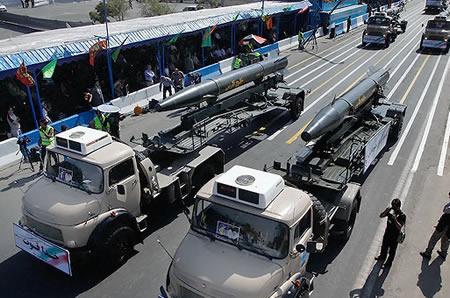
Iranian Fatah 110 Gen IV (guided) Missiles
In recent weeks Iran has introduced new guided weapon systems claimed to be based on indigenous developments. Among these weapons are the Shahed 129 attack Unmanned Aerial Vehicle (UAV), precision guided version of the Zelzal medium range rocket, and Taer medium-range air-defense missile, positioned to be a precursor for the country’s new category of air defense weapon systems.
As for the improved precision of Zelzal-2, Major General Mohammad Ali Jafari, Commander of the Islamic Revolution Guards Corps confirmed the level of accuracy of Zelzal rockets has been increased, “the precision [of Zelzal rockets has been increased and their margin of error has been lowered to less than 50 meters," the IRGC commander explained.
General Jafari confirmed the country’s missile development is back on track, following the devastating explosion occurred during a test, on November 12, 2011. The explosion killed 17, among them General Hassan Tehrani Moqaddam, known as the father of the Islamic Republic missile technology. “Iran’s missile development has been delayed in about six months after this event” Jafari said in a recent interview to the Fars news agency. He said the explosion took place at the IRGC center in the vicinity of Tehran, when scientists were conducting research on solid fuel for satellite carries. "It was just a part of our missile research program that was hit by the accident.” General Jafari said, “The accident could only delay our research for 6 months and now the program is back on."
As part of its strategic missile program, Tehran is deploying part of its missiles on transportable launchers. While missiles propelled by solid-rocket, maintained in high readiness and are ready for launch within minutes, missiles propelled by liquid fuel require lengthy refueling and are therefore much more vulnerable to preemptive attack. These missiles are likely to be stored in underground silos – such as the Jask-2, recently unveiled by the Iranian military. Such a facility was first unveiled during the opening stage of the 2011 ‘Great Prophet 6’ exercise, where ballistic missiles were fired against, and destroyed a naval surface target.
According to senior commanders of the IRGC Aerospace Force, Iranian experts have been busy with developing the technology and infrastructures for the underground silos for the last 15 years. The pads have the capability to launch different types of missiles, including long-range Shahab class missiles.
Iran is also developing a new air defense missile system dubbed Raad. 6x6 transporter vehicles each carrying three ‘Taer’ missiles were displayed on the annual military march in Tehran in September. The system is claimed to be of a local development, include a radar system, fire control complex and multiple missile transporter-launchers. The missile is said to be effective against aircraft, helicopters and drones, it has an intercept range of 50 kilometers and the system is claimed to be effective at altitudes from70 to 70,000ft (22 km).
To learn about the new Iranian missiles, Sign up for Defense-Update Premium Account to know more…
In addition to the medium air defense systems Iran has also invested in the development of early warning systems based on indigenous design. In June 2011, the IRGC marked the first deployment of the long-range Ghadir radar system, allegedly capable of tracking aerial targets at ranges up to 500 km (‘coverage of 1,100 km range’) and at altitude of 300km, making it capable of tracking satellites orbiting at ‘very low earth orbits’, according to Iranian sources. (most LEO satellites are, however, orbiting at higher altitudes). The radar operates over a wide frequency range. The Iranians also said their new radar can detect claim the Ghadir can detect radar-evading aircrafts (stealth), cruise missiles and ballistic missiles as well. Another radar developed indigenously is capable of detecting Unmanned Aerial Vehicles (UAVs), assisting air defense weapon systems to engage such targets.
»»  READMORE...

Switzerland Transfers 12 Leopard 2s to Canada


Posted by 
Email this page
Implementing the Armed Forces 95 and Armed Forces XXI programs, Switzerland is phasing out some of its heavy armor units. As part of this program Bern will transfer 12 Leopard 2 main battle tanks (Pz 87 Leo) to Canada. More of of the Swiss Pz 87 Leo fleet was therefore mothballed at various storage sites.
In recent years Canada has acquired surplus Leopard 2 tanks from a number of European countries, supporting its military operations in Afghanistan. 100 tanks (80 Leo 2A4, 20 Leo 2A6) were bought from the Netherlands in 2007. Twenty additional Leopard 2A6M were ‘borrowed’ from Germany from mid-2007 to support the Canadian deployment in Afghanistan, along with two Bergepanzer 3 Büffel (Buffalo) armored recovery vehicles. Canada has also acquired 15 German Army surplus Leopard 2A4 tanks to be used for spare parts. According to the Swiss Government announcement, the Swiss tanks to be delivered to Canada will be converted into support vehicles. The tanks are being transferred from Switzerland were stripped of the armament, radio-and intercom systems, to be used as spare parts for the Swiss Armed Forces.
Switzerland is transferring 12 Pz87 Leo (Leopard 2) tanks to Canada, to be converted into 'support vehicles'.
Switzerland has bought 380 Leopard 2 tanks from Germany (of which 345 were locally built in Switzerland) to equip its heavy mechanized units; these tanks were delivered between 1987 and 1993. 134 of the tanks went through mid-life upgrade program in 2006. As part of the current force reduction, 12 tanks were converted into armored engineer and mine clearing vehicles designated “Pionierpanzer 3 Kodiak”, a combat engineering and mine-clearing vehicle, supporting the mechanized brigades.
»»  READMORE...

New AC-130J Gunship In Production


Posted by 
Email this page
MC-130J Super Spectre gunship. Photo: Lockheed Martin
The first MC-130J Commando II that will be converted to become an AC-130J Gunship is being built at theLockheed Martin C-130 production facility here. The AC-130J will be equipped with a Precision Strike Package creating the U.S. Air Force Special Operations Command’s newest gunship. Sixteen AC-130Js are planned with an Initial Operating Capability scheduled for 2015.
»»  READMORE...

US Navy Receives the First MQ-8C VTUAV


Posted by 
Email this page
Northrop Grumman has delivered the first MQ-8C aircraft to the US Navy in early July, in preparation for ground and flight testing. ”The endurance upgrade doubles the time on station of the MQ-8 system and will help reduce the workload for the ship’s crew by cutting the number of times the crew will need to be in flight quarters,” said George Vardoulakis, vice president, medium range tactical systems for Northrop Grumman. “Ground and flight testing are the next steps in meeting the urgent requirement for maritime intelligence, surveillance and reconnaissance. Testing on the Naval Air Systems Command test range provides us with extended air space to conduct and demonstrate long endurance and systems testing in a maritime environment.” Northrop Grumman is the US Navy’s prime contractor for the MQ-8 Fire Scout program of record. The first deployment of the upgraded MQ-8 system with the MQ-8C Fire Scout aircraft will be in 2014.
AUS&R 650x90b
Book your place at the AUSR 2013 Expo in Israel – for a special Low Rate – Valid only through July 31, 2013!
The upcoming tests will be used to validate and mature the upgraded MQ-8 system for operational use. Initial ground testing will ensure that the systems work properly and communicate with the ground control station prior to conducting first flight. The MQ-8 system with the upgraded MQ-8C aircraft will share proven software, avionics, payloads and ship ancillary equipment with the MQ-8B aircraft.
The upgraded Fire Scout responds to an urgent need to provide the Navy with increased endurance, range and payload. Using a modified, commercially available Bell 407 airframe, the upgraded MQ-8 system can provide commanders with three times the payload and double the endurance at extended ranges compared to the current MQ-8B variant based on the Schweizer 330SP platform. The MQ-8B aircraft currently operates at sea on US Navy frigates and on land in Afghanistan, where it provides intelligence, surveillance and reconnaissance capabilities to maritime and ground commanders.
The first MQ-8C Fire Scout delivered to the Naval Air Systems Command (U.S. Navy photo by Vance Vasquez)
»»  READMORE...

The ‘Dambusters’ will be the first British unit to receive the F-35B


Posted by 
Email this page
617sqnbadge150
617 Squadron is probably the most famous squadron in the RAF. It was created in 1943 to carry out attacks with a level of accuracy then unprecedented. It gained its epithet “The Dambusters” after its first raid, for which it was initially formed, to destroy dams in the Ruhr valley in Nazi Germany. The Squadron has twice been disbanded and reformed as it has moved from operating the Lancaster to the Vulcan to the Tornado, in a process that is usual for all RAF squadrons.
The Royal Air Force has announced that 617 Squadron, the famous ‘Dambusters’, will be the first operational squadron using F-35B Lightning II aircraft. According to Chief of the Air Staff, Air Chief Marshal Sir Stephen Dalton, the 617 Squadron is to disband on 1st April next year, as part of the planned drawdown of the Tornado GR4 force. It will then reform in 2016, taking delivery of the highly advanced Lightning II. Dalton made the announcement at a Royal United Services Institute (RUSI) conference on Air Power this week. Later this year 617 Squadron will deploy to Afghanistan for the last time as a Tornado GR4 Squadron to support NATO and Afghan troops.
Dalton added that the Lightning II shall be operated jointly by the Royal Air Force and Fleet Air Arm pilots, from land or from the Queen Elizabeth Class carrier. Overall, a hugely flexible and futuristic joint capability. When it reforms in 2016, 617 Squadron will have both RAF and Royal Navy personnel. The next squadron will carry a Royal Navy squadron number but be similarly jointly manned.
“The Lightning’s state of the art stealth and precision target capabilities, together with the battle-proven Typhoon force, will complement each others’ capabilities and set the base-line for UK Combat ISTAR2 air power as a contemporary global force for the 2020s and beyond.” Dalton added. The UK’s Lightning II is the Short Take Off and Vertical Landing (STOVL) variant of the Joint Strike Fighter, which will give the supersonic multi-role stealth aircraft the ability to operate from land or sea.
»»  READMORE...

KENDARAAN LAPIS BAJA PENYIMPAN RANJAU SHIELDER


Shielder
Shielder adalah kendaraan tempur penyimpan ranjau.Ranjau –ranjau ini adalah ranjau anti tank.ia juga mampu untuk meletakan ranjau anti personel.namun setelah Inggris menandatangani Konvensi ranjau anti personil,Angkatan Darat Inggris tidak menggunakannya.Sebanyak 29 Shielder telah di order oleh kementrian pertahanan Inggris pada tahun 1995.Kendaraan pertama dikirim pada tahun 1999.

Shielder dioperasikan oleh Royal Engineer,ia menciptakan hambatan anti tank dengan cepat dan efektif,sehingga mengurangi mobilitas pasukan musuh.

Sistem penyimpan ranjau scatterable didasarkan pada versi flatbed Stormer kendaraan personil lapis baja.Shielder menggunakan sistem penyimpan ranjau  AS-M163 yang terpasang pada flatbed.Kendaraan membawa dispenser pada rak peluncur.setiap dispenser berisi 6 ranjau anti tank.

Ranjau anti tank ini telah diprogram sehingga ketika habis masa pakainya ia akan hancur dengan sendirinya.Ranjau akan hancur dengan sendirinya setelah beberapa jam atau hari.

Lapis baja pada Shielder tahan terhadap senjata ringan dan serpihan artileri.Dipersenjatai dengan senapan mesin 7,62 mm yang merupakan senapan atap tunggal yang terletak pada bagian palka atas.

Shielder dioperasikan oleh dua orang termasuk Komandan dan pengemudi.


photo 01photo 02photo 03


»»  READMORE...