News in Picture

Related Posts Plugin for WordPress, Blogger...
Showing posts with label UAV. Show all posts

Thursday, October 30, 2014

MENHAN TARGETKAN INDONESIA PRODUKSI PESAWAT PENGINTAI

Kerjasama dengan Korea Selatan
UAV Lapan 

Kementerian Pertahanan (Kemenhan) melakukan alih teknologi. Upaya itu bertujuan meningkatkan kemandirian Indonesia untuk memproduksi alat utama sisstem senjata (alutsista).

Dalam jangka waktu lima tahun, kata Menteri Pertahanan Jenderal TNI (purn) Ryamizard Ricudu di Jakarta, Rabu (29/10/2014), Indonesia akan memproduksi sendiri pesawat pengintai. Indonesia menggandeng Korea Selatan dalam produksi tersebut.

Menurut mantan Kepala Staf TNI AD (KSAD) itu, alih teknologi di bidang pertahanan perlu untuk memenuhi kebutuhan pengamanan Indonesia. Tujuannya yaitu menjaga kedaulatan NKRI.

Namun ia belum dapat memastikan keinginan Presiden Joko Widodo untuk membeli pesawat tanpa awak. Untuk saat ini, akunya, pengawasan pertahanan Indonesia masih mengandalkan kamera satelit.[RRN]
source: abarky

»»  READMORE...

Saturday, May 24, 2014

Iran Luncurkan Tiruan Drone RQ-170 AS


Republik Islam Iran telah meluncurkan versi produk dalam negeri dari drone canggih Amerika Serikat, RQ-170  yang ditangkap militer Iran pada tahun 2011.

Menurut laporan Press TV, drone siluman tersebut diresmikan di sebuah pameran di Pusat Komando Pasukan Aerospace Korps Garda Revolusi Islam (IRGC), Ahad (11/5).

Pameran itu dihadiri oleh Rahbar atau Pemimpin Besar Revolusi Islam Iran, Ayatullah al-Udzma Sayid Ali Khamenei.

Drone-drone Iran lainnya, termasuk Shahed 129 dan 125, juga dipajang di pameran tersebut.

Dalam pameran yang dikunjungi Rahbar itu, IRGC menampilkan berbagai prestasi dalam mendesain dan mengembangkan pesawat tanpa awak, radar dan sistem-sistem pertahanan seperti sistem rudal anti-kapal, balistik dan anti-perisai.

RQ-170 Sentinel milik Amerika Serikat berhasil ditiru oleh para ahli IRGC dalam waktu sekitar dua tahun.

RQ-170 adalah pesawat siluman tak berawak yang dirancang dan dikembangkan oleh Perusahaan Lockheed Martin.

Pesawat itu berhasil didaratkan dengan kerusakan minimal oleh unit perang elektronik Angkatan Darat Iran pada 4 Desember 2011, ketika terbang di atas kota Kashmar, Iran, sekitar 225 kilometer dari perbatasan Afghanistan.

Pada saat itu, para pejabat militer AS mengatakan bahwa Iran tidak memiliki teknologi untuk menguraikan rahasiadrone tersebut. Namun, para ahli Iran berhasil memecahkan data yang diambil dari RQ-170, dan bahkan menirunya. (IRIB Indonesia/RA
)
»»  READMORE...

Saturday, May 10, 2014

Airbus invites partners to test mission payloads with Zephyr 8 ‘Pseudo-Satellite’


Airbus Defence and Space has launched a High Altitude Pseudo Satellite (HAPS) program developing a commercial variant of the world record setting Zephyr 7 high altitude long endurance (HALE) solar-powered unmanned aerial vehicle. Zephyr 8 will develop the next generation platform, designed to operate at very high altitude, as a pseudo-satellite.
Airbus’ subsidiary Astrium has been working on HAPS since 2008 in cooperation with the group’s defence subsidiary Cassidian and Innovation Works. For several years the program was managed as a cross-divisional nursery project, integrated a team of space and aviation specialists. In 2013 Astrium, now part of Airbus Defence and Space acquired the Zephyr assets from QinetiQ, integrating the Zephyr staff into Airbus’ HAPS organization.
Astrium is now set to develop a High Altitude Pseudo-Satellite offering that will provide a valuable augmentation to its existing space based services for communications and remote sensing
Running exclusively on solar power and flying at high altitudes above the weather and above commercial air traffic, Zephyr 8 will bridge the gap between satellites and UAVs. Unlike reconnaissance satellites that monitor the earth surface from low-earth orbit, these HAPS will be able to persist over an area of interest providing satellite-like communications and intelligence, surveillance and reconnaissance (ISR) services without interruption. Through these evaluations Airbus’ Zephyr team is ready to help customers design, build and operate the mission payloads, or provide the necessary interface to integrate those payloads in upcoming test flights.
In 2010 the Zephyr 7 successfully achieved several world records, including the longest flight duration without refuelling (14 days), that was ten times longer than any other aircraft achieved before. It also flew at very high altitude, as high as 70,740 ft. The Zephyr 7 went through final testing in 2013, clearing the way for the next generation Zephyr 8.
According to Jens Federhen, Airbus HAPS program manager the team is now focused on the follow-on Zephyr 8, that will be able to carry and test various mission payloads. “We are ready and looking forward to demonstrating its unique capabilities to customers, in flight” Federhen said.
“Zephyr 7 was years ahead of any other HAPS system.” Zephyr Technical Director Chris Kelleher said, “We spent the last year analysing and designing exactly what we need to improve it”. Kelleher said Airbus has received permissions to fly Zephyr in test ranges in Australia, the USA and Europe.
Five months after the acquisition of Zephyr from QinetiQ, Zephyr 7 flown by Astrium (Airbus Defence and Space) at the Polygon Test Yuma, Arizona (USA) in August 2013. The company is working now on an enhanced Zephyr 8, that will be able to carry various mission payloads. Testing approvals for Zephyr 8 were received from test ranges in the USA, Australia and Europe. Photo: AIrbus Defence and Space
Five months after the acquisition of Zephyr from QinetiQ, Zephyr 7 flown by Astrium (Airbus Defence and Space) at the Polygon Test Yuma, Arizona (USA) in August 2013. The company is working now on an enhanced Zephyr 8, that will be able to carry various mission payloads. Testing approvals for Zephyr 8 were received from test ranges in the USA, Australia and Europe. Photo: Airbus Defence and Space
»»  READMORE...

Peningkatan Prestasi Terbang UAV Wulung


Program pengujian prestasi terbang sistem PUNA Wulung hasil kerjasama Balitbang KEMHAN dan BPPT telah dilaksanakan oleh Tim PUNA PTIPK – TIRBR pada tanggal 22 – 02 Mei 2014 di bandara Nusa Wiru, Cijulang, Pangandaran, Jawa Barat. 

Pengujian terbang ini ditujukan untuk mengetahui peningkatan prestasi terbang sistem PUNA Wulung PA 08, PA 09 dan PA 10 yang merupakan prototip hasil penyempurnaan desain PUNA karya BPPT terbaru. Ke tiga prototip PUNA Wulung tersebut dipersiapkan untuk program misi pemantauan (surveilance & recoqnition) keperluan militer TNI dalam operasi patroli perbatasan dengan durasi terbang dapat mencapai 6 jam dengan jarak jangkauan sekitar 120 Km dari home base. Kriteria spesifikasi teknis ini merupakan angka yang disepakati sebagai performance PUNA Wulung untuk diproduksi.
 

Untuk meningkatkan kemampuan durasi terbang sistem PUNA Wulung dari 4 jam ke 6 jam, pada prototip Wulung PA 08, PA 09 dan PA 10 dilakukan peningkatan kapasitas tangki bahan bakar dari sebelumnya 35 liter menjadi 55 liter. Konsekwensi dari penambahan berat tambahan bahan bakar ini membuat konstruksi pesawat PUNA Wulung harus lebih ringan dari versi sebelumnya agar berat maksimum saat takeoff tidak berubah (MTOW 120kg) disamping kekuatan struktur ditingkatkan dari 3,5G ke 7,6G untuk mengantisipasi penggunaan pada misi modifikasi cuaca yang membutuhkan kekuatan struktur yang extra karena operasi penerbangan pada kondisi extrem.

Tantangan membuat konstruksi pesawat yang lebih ringan dengan kekuatan struktur lebih kuat membuat tim harus bekerja keras melakukan rekayasa proses manufaktur agar dicapai pengurangan berat yang akan digantikan oleh penambahan bahan bakar.

Pada uji terbang kali ini PTIPK mulai menggunakan kendaraan Ground Control Station (GCS) milik BPPT yang terbaru dilengkapi telescopic antena system.  Hal ini memungkinkan sistim kendali PUNA serta transmisi data dari PUNA ke GCS dapat dilakukan secara lebih cepat dan praktis dan diharapkan pergerakan dan darihome base dengan baik. Dari kegiatan uji terbang ini hasil prestasi terbang sistem PUNA Wulung terpantau dan hasil pengiriman dokumentasi data terbang PUNA tercatat pada GCS

Sebagai hasil dari uji terbang tanggal 1 Mei 2014, PUNA Wulung PA 09 tercatat telah mencapai terbang sejauh 150 Km pada ketinggian terbang 6000 ft kearah baringan selatan 125 deg dengan menggunakan sistem komunikasi kombinasi line offset dan sistem satelit iridium.

Dalam acara kegiatan pengujian sistem PUNA Wulung PA 08, PA 09 dan PA 10  - BPPT di Pelabuhan Udara Nusa Wiru, Jawa Barat tersebut turut serta menyaksikan a.l Deputi Ka. BPPT Bidang TIRBR selaku penanggung jawab program, Direktur Pustekinhan TIRBR BPPT, Kepala Pusiptekhan Balitbanghan KEMHAN, perwakilan dari PT Dirgantara Indonesia, perwakilan TNI AU lanud Parigi, perwakilan mitra kerja. Kedepan masih perlu dilakukan beberapa kali uji terbang untuk meningkatkan kehandalan (reliability) dari sistem PUNA Wulung yang mencakup uji jangkauan jauh (Long range), ketinggian maksimum terbang (high altitude) serta untuk melengkapi uji kemampuan terbang PUNA PA 08, PA 09 dan PA 10.


Sumber : BPPT
»»  READMORE...

Wednesday, May 7, 2014

US Navy Requests Industry Proposals for Carrier-Operable Drones


Following almost a year of delay, and gathering more confidence with drone operations from carriers, the US Navy is moving forward with Unmanned Carrier Launched Airborne Surveillance and Strike (UCLASS) - the future carrier operated drones 


X-47B Unmanned Combat Air System (UCAS-D) completes preparations for launching aboard the aircraft carrier USS Theodore Roosevelt (CVN 71). Theodore Roosevelt is the third carrier to test the tailless, unmanned autonomous aircraft’s ability to integrate with the carrier environment. The future UCLASS will be optimized to operate with the new Ford Class carrier (CVN-78) fitted with electrically rather the conventional steam powered catapult, enabling safe handling of lighter aircraft. (U.S. Navy photo by Heath Zeigler)


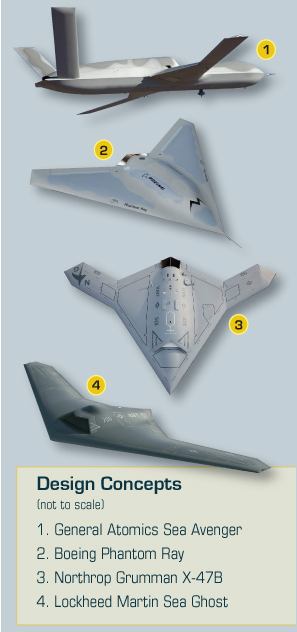
The four candidate designs considered for UCLASS depicted in this image published by the US Naval Institute (USNI)
Future drone attacks could be more pervasive and less constrained by access permissions and host country support, once the US Navy goal to integrate unmanned systems capabilities on board its aircraft carriers is fulfilled. Current operations, conducted by the CIA and Air Force from land-based sites are constrained to the availability, permission and security provided by host nations, bases that should be located relatively close to the target and, hence, may compromise operational security and operator safety. New generations of drones to be operated by the US Navy from aircraft carriers could introduce a new capability, unbound by those restrictions.
Following a year-long delay the U.S. Navy released a draft request for proposal (RFP) for the Unmanned Carrier Launched Airborne Surveillance and Strike (UCLASS) aircraft on April 17, 2014. The draft release was delayed due to disagreements within the Navy, about the technical specifications for the future unmanned aircraft. The final RFP is expected later this year. The new carrier-operated drone is scheduled to enter service in the early 2021.
Four prime contractors are participating in the competition –General Atomics Aeronautical Systems Inc, BoeingLockheed Martin and Northrop Grumman. All four have already been contracted to carry out preliminary studies of a UCLASS type drone and are likely to submit their proposals for the final design. The current draft RFP calls bidders to submit proposals for design, development, assembly, delivery, testing and integration of the air vehicles segment of the UCLASS system. Other elements are likely to include sensors, datalinks, command and control systems.
The US Navy made history last year when the X-47B became the first unmanned air vehicle to launch off the CVN-77 George W. Bush aircraft carrier’s catapult and perform an arresting gear landing. In those cases the X-47B was alone on the carrier. Moving forward, the Navy plans to continue testing the unmanned drone operating as part of a carrier air group. These flights are scheduled to take place in the Atlantic Ocean this summer, aboard the USS Theodore Roosevelt (CVN-71).
UCLASS will be a key Intelligence, Surveillance and Reconnaissance (ISR) asset for future carrier air groups, enabling each carrier of the CVN-78 Ford class to support two continuous ISR orbits at “tactically significant ranges” over uncontested airspace.
In preparation for these flights an X-47B carried out its first night flight at Naval Air Station Patuxent River, Md. The flights planned for this summer will be carefully scripted to measure and account for any variables. The Navy will initially focus on low-tempo operations but could sometime in 2015 intensify the tempo if there is funding and an available aircraft carrier. Aircraft carrier are normally operating on operational cycles of 12 hours each, and all future unmanned assets would be required to align to these operational tempo.
The UCLASS will benefit from lessons learned through these evaluations. According to Rear Adm. Mat Winter, NAVAIR’s program executive officer for unmanned aviation and strike weapons, UCLASS will be a key Intelligence, Surveillance and Reconnaissance (ISR) asset for future carrier air groups, enabling each carrier of the CVN-78 Ford class to support two continuous ISR orbits at “tactically significant ranges” over uncontested airspace. The aircraft would have some stealth capabilities to enable it to operate in ‘lightly contested’ areas.
The Navy has budgeted the UCLASS capability at a $150 million per orbit. Assuming that two air vehicles can cover one orbit (if that aircraft is capable of flying for 14 hours), that means the maximum price point for a UCLASS air vehicle is about $75 million, USNI said, quoting industry sources. According to preliminary specifications released in June 2013 the goal for UCLASS was to conduct two unrefueled orbits at 600 nautical miles (1,111 km) or one unrefueled orbit at 1,200 nautical miles (2,222 km).
UCLASS drones will also have moderate stealth characteristics and internal payload carrying capacity to conduct light strike missions to eliminate targets of opportunity. Additional roles for the UCLASS could also be aerial refueling, albeit, given their limited payload capacity, such missions could be relevant primarily for other UAS.
The original spec called for a minimum payload capacity of 3,000-pound (1,360 kg), to include electro-optic/infrared (EO/IR) surveillance and signals intelligence capability similar to the current MQ-1 Predator and MQ-9B Reaper. The Navy would also like to have a modular radar payload to include synthetic aperture radar and moving target indicator (SAR/GMTI) as well as maritime area search radar capability. In addition, the aircraft will be able to carry 1,000 lbs (454 kg) of external load, primarily weapons.
An X-47B Unmanned Combat Air System (UCAS) demonstrator prepares to launch from the flight deck of the aircraft carrier USS George H.W. Bush (CVN 77). George H.W. Bush was the first aircraft carrier to successfully catapult launch an unmanned aircraft from its flight deck. (U.S. Navy photo by Brian Read Castillo)
An X-47B Unmanned Combat Air System (UCAS) demonstrator is towed into the hangar bay of the aircraft carrier USS George H.W. Bush (CVN 77). (U.S. Navy photo by Timothy Walter)
Part of the Demonstrator Unmanned Combat Air System - Demonstrator (UCAS-D) testing was to demonstrate how an unmanned aircraft can operate within the crowded and complex carrier environment. In this photo the Northrop Grumman X-47B is seen towed into the hangar bay on board the aircraft carrier USS George H.W. Bush (CVN 77) which was one of three carriers that participated in the evaluation. Key design parameters of the UCLASS program will be based on the lessons learned through the UCAS-D evaluations. (U.S. Navy photo by Timothy Walter)
»»  READMORE...

Sunday, April 27, 2014

Brimstone Completes Drone Test Trials


MBDA has successfully demonstrated the operation of Dual Mode Seeker Brimstone (DMB) missile from an MQ-9Reaper Remotely Piloted Aircraft (RPA), scoring nine direct hits against a range of targets including very high speed and manoeuvring vehicles. The main advantage of Brimstone is its dual-mode operating capability, combining millimetre guidance with semi-active laser targeting, enabling the operator to accurately designate a target, after the milimeter-wave seeker locks on the designated target the missile independently follows that target independent of further laser designation, through the engagement. The tests pave the way for the deployment of the weapon on Britain’s MQ-9Reapers. Beyond their use with aerial platforms, Brimstones were also been tested on fast naval crafts, fired against speedboat simulating swarm attacks.


MQ-9 Reaper carrying six Dual-Mode Brimstone missiles. Photo: MBDA
The trials began with captive carry of Avionics and Environmental Data Gathering Missiles, proving the successful integration of the two systems and gathering additional evidence to support future clearance activities. These were quickly followed by a series of live Operational Missile and inert Telemetry Missile firings. The firings were taken from realistic ‘middle of the envelope’ profiles; typically 20,000ft release altitude and 7km – 12km plan range, with the platform being remotely piloted in operationally representative beyond line of sight (SATCOM) conditions, with tracking and designation of targets being conducted in a mixture of manual-track and auto-track modes. Two of the more challenging scenarios were against trucks travelling at 70mph in a crossing target scenario.  At times, the targets were manually tracked by the REAPER crews, showing how the integrated Semi-Active Laser and Active MMW radar seeker works in tandem to ensure direct hits, even while operators are tracking and designating targets manually over satellite communications. “Every Operational and Telemetry missile performed as designed” MBDA announced, “Following the successful demonstration Brimstone can now provide more flexibility to Reaper operators, reducing collateral damage risk while retaining first pass, single shot lethality against high speed manoeuvring targets on land, at sea and in complex environments.”
brimstone_target_50mph700
A Brimstone missile hitting a target moving at a speed of 50 miles per hour (80 km/h). Photo: USAF Big Safari
The original Brimstone missile used a milimeter-wave seeker to defeat massive armor formations in ‘fire and forget’ engagements. Royal Air Force (RAF) Tornado GR4 strike fighters were fitted to carry clusters of Brimstones, to kill multiple tanks in a simultaneous attack. DMSB, the new variant of the missile was optimised to engage asymmetric threats, by turning the fire-and-forget missile into high-precision weapon combining some ‘man in the loop’ capability, allowing the operator to designate the target for the missile, in case the MMW seeker couldn’t lock or was looking elsewhere. In an asymmetric engagement, ‘man in the loop’ function enables the operator to correct a missile that locks on the wrong target, divert the missile to an alternate target or order the missile to abort attack, hitting a pre-defined area, thus avoiding collateral damage. In addition to the dual-mode seeker capability, Brimstone fired from Tornado GR4 demonstrated the ability to engage, from a high off-boresight, targets travelling at up to 70mph. The targets were engaged from longer ranges, without the need to revert to straight and level flight, whilst operating in Close Air Support (CAS) role. These tests were carried out by the RAF in October 2013.
The use of MMW seeker enables the missile to effectively engage moving targets, a task that would require multiple Hellfire missiles. MBDA is employing a focussed, low fragmentation warhead optimised to defeat targets from Fast In-Shore Attack Craft Fast In-Shore Attack Crafts (FIAC) to fast moving armored or unarmored vehicles. In Libya, those characteristics reportedly made it one of the few weapons NATO commanders could use to hit enemy armored vehicles in urban areas.
MBDA is lobbying the USA to select the Dual Mode Brimstone missile to arm the Reaper drones operated by the US government, as an alternative to pursuing further investment in the Joint Air-Ground Missile (JAGM). This missile, developed by Lockheed Martin, was designed to replace Hellfires used by all US military services but is currently pursued only by the Army. It will also employ a dual-mode seeker combining the Hellfire laser seeker and Longbow MMW radar seekers in a similar way the utilised by the Brimstone.
brimstone_cutaway
MBDA is lobbying the USA to select the Dual Mode Brimstone missile to arm the Reaper drones operated by the US government, as an alternative to pursuing further investment in the Joint Air-Ground Missile (JAGM).
»»  READMORE...

Sunday, April 20, 2014

DARPA’s Selects Four Developers for new X-Plane Program

Karem Aircraft proposed a drone utilizing the company's proprietary Optimum Speed Tilt-Rotor (OSTR) technology to provide its VTOL X-Plane design unique advantages in speed, range and endurance.

Karem Aircraft proposed a drone utilizing the company’s proprietary Optimum Speed Tilt-Rotor (OSTR) technology to provide its VTOL X-Plane design unique advantages in speed, range and endurance.

DARPA has tasked four companies with designing new aircraft to revolutionise vertical takeoff and landing (VTOL) flight capabilities. The four are Aurora Flight Sciences Corporation, The Boeing Company, Karem Aircraft, Inc. and Sikorsky Aircraft Corporation. The next major milestone for VTOL X-Plane is scheduled for late 2015, when the four performers are required to submit preliminary designs. At that point, DARPA plans to review the designs to decide which to build as a technology demonstrator, with the goal of performing flight tests in the 2017-18 timeframe. (Full story is available here)
For generations, new designs for vertical takeoff and landing aircraft have remained unable to increase top speed without sacrificing range, efficiency or the ability to do useful work. DARPA’s VTOL Experimental Plane (VTOL X-Plane) program seeks to overcome these challenges through innovative cross-pollination between the fixed-wing and rotary-wing worlds, to enable radical improvements in vertical and cruise flight capabilities. In an important step toward that goal, DARPA has awarded prime contracts for Phase 1 of VTOL X-Plane to the four companies.
Boeing has developed this concept UAS at its phantom works using advanced design methods. The X-Plane win will enable toe creation of large scale air vehicle of this type. Image: Boeing
Boeing has developed this concept UAS at its phantom works using advanced design methods. The X-Plane win will enable toe creation of large scale air vehicle of this type. Image: Boeing
“We were looking for different approaches to solve this extremely challenging problem, and we got them,” said Ashish Bagai, DARPA program manager. “The proposals we’ve chosen aim to create new technologies and incorporate existing ones that VTOL designs so far have not succeeded in developing. We’re eager to see if the performers can integrate their ideas into designs that could potentially achieve the performance goals we’ve set.”
VTOL X-Plane seeks to develop a technology demonstrator that could achieve a top sustained flight speed of 300 – 400 kt, raise aircraft hover efficiency from 60 percent to at least 75 percent and Carry a useful load of at least 40 percent of the vehicle’s projected gross weight of 10,000-12,000 pounds. Another goal will be to present a more favorable cruise lift-to-drag ratio of at least 10, up from 5-6.
All four winning companies proposed designs for unmanned vehicles, but the technologies that VTOL X-Plane intends to develop could apply equally well to manned aircraft. Another common element among the designs is that they all incorporate multipurpose technologies to varying degrees. Multipurpose technologies decrease the number of systems in a vehicle and its overall mechanical complexity. Multipurpose technologies also use space and weight more efficiently to improve performance and enable new and improved capabilities.
Sikorsky has also been selected for the VTOL X-Plane flyoff competition in 2015.
(defense-update)
»»  READMORE...

Saturday, April 19, 2014

North Korean mini-Drones are Made in China

The mini drones operated by North Korea over South Korea are the SKY 09 made in China by the Taiyuan Navigation Technology company. The models operated by North Korea was equipped with a muffler, to reduce the drone's acoustic signature. Photo: Taiyuan

The mini drones operated by North Korea over South Korea are the SKY 09 made in China by the Taiyuan Navigation Technology company. The models operated by North Korea was equipped with a muffler, to reduce the drone’s acoustic signature. Photo: Taiyuan
According to ‘Alert 5‘ news blog, these drones are commercial off-the-shelf SKY-09P models made in China, by TaiyuanNavigation Technology. Based on the manufacturer’s data this mini-drone is launched by a catapult and retrieved by parachute. It can carry a payload of 3 kg on a 90 minute mission, controlled in flight over a distance of 30-40 km.  The company also offers a larger variant, SKY-19 that can fly for two hours and carry 5kg of payload.
The mini drones operated by North Korea over South Korea are the SKY 09 made in China by the Taiyuan Navigation Technology company. The models operated by North Korea was equipped with a muffler, to reduce the drone’s acoustic signature.
This mini-UAV was found in October 2013 on the east coast area of South Korea, near the town of Samcheok.
»»  READMORE...

Tuesday, April 15, 2014

Pertama di Dunia, UCAV Terbang Formasi dengan Pesawat Berawak

nEUROn, Rafale dan Falcon 7X


Pada 20 Maret 2014, Dassault Aviation membuat penerbangan formasi unik dimana pesawat tempur tak berawak (UCAV) nEUROn terbang bersama sebuah jet tempur Rafale dan jet bisnis Falcon 7X, yang keduanya diproduksi oleh perusahaan ini. Pengorganisiran penerbangan formasi semacam ini sangat menantang, apalagi ketika pada saatnya harus bermanuver bersama-sama, ujar juru bicara Dassault Aviation di laman resmi perusahaan.

Tantangan terberat lainnya adalah mengendalikan UCAV nEUROn yang tanpa awak di dekat empat pesawat lainnya yang berawak (selain Rafale dan Falcon 7X, ada dua pesawat untuk fotografi yang mengikuti). Operator harus merencanakannya secara matang dengan memperhitungkan risiko gangguan, termasuk turbulensi aerodinamis antara pesawat. Selain itu gangguan komunikasi antar pesawat dan dengan stasiun kontrol di darat juga tidak boleh ada gangguan.

"Pencapaian ini jelas mencerminkan keahlian kami dalam teknologi. Kemampuan kami dalam penerbangan militer dan sipil saling memperkaya satu sama lain, yang memungkinkan kami untuk menghadirkan pesawat terbang yang luar biasa baik untuk angkatan bersenjata maupun pelaku bisnis pesawat Falcon," Eric Trappier, Chairman dan CEO dari Dassault Aviation berkomentar.


nEUROn, Rafale dan Falcon 7X


Penerbangan formasi semacam ini adalah yang pertama kali di dunia, yaitu drone tempur udara terbang bersama pesawat lain. Memang drone sering dikawal oleh pesawat chase (pengikut), yang merupakan bagian dari ujian penerbangan, tapi ini bukan dilakukan untuk tujuan terbang formasi, dimana drone akan dikoordinasikan dengan baik dengan pesawat lain dalam sebuah formasi. Seluruh kegiatan ini berlangsung selama 110 menit di atas Mediterania dengan jangkauan terbang beberapa ratus kilometer.

nEUROn adalah program pengembangan purwarupa pesawat tempur tak berawak (Unmanned Combat Air Vehicle (UCAV)) Eropa. Dassault aviation diposisikan sebagai kontraktor utama di bawah otoritas agen pengadaan pertahanan Perancis, yang merupakan kerja gabungan ilmuwan-ilmuwan dari Perancis, Italia, Swedia, Spanyol, Yunani dan Swiss.

»»  READMORE...

Sunday, April 13, 2014

Korut Kerahkan Pesawat Tak Berawak Matai-matai Korsel

Kementerian Pertahanan Korea Selatan meyakini tiga drone (pesawat tak berawak) yang jatuh dalam beberapa pekan terakhir ini adalah buatan Korea Utara.
Korut Kerahkan Pesawat Tak Berawak Matai-matai Korsel

Seperti diketahui, reruntuhan drone ditemukan di tiga tempat yang berbeda, termasuk di Pulau Baengnyeong dekat perbatasan laut yang disengketakan.

"Dengan memeriksa tiga pesawat dan perangkat yang ada, kita sudah mengamankan sejumlah bukti pecahan yang mengarah ke Korea Utara," kata Kementerian Pertahanan dalam sebuah pernyataan pers.

Ketiga kendaraan udara tak berawak yang panjangnya sekitar satu meter, lebar dua meter dan dicat biru pucat itu dilengkapi dengan kamera.

Chip memorinya berisi foto-foto wilayah perbatasan dan ibukota Seoul, termasuk istana kepresidenan, meskipun foto-foto berkualitas rendah. Kementerian itu menambahkan bahwa para ahli forensik AS akan membantu menganalisis drone.(JN)
»»  READMORE...

Australia Continues Heron I Mission in Afghanistan

Heron I RPA are operating from Kandahar airbase, Afghanistan and from Woomera Test Range in South Australia, where operators are trained for the missions in Afghanistan. Photo: RAAF, Aaron Curran

Heron I RPA are operating from Kandahar airbase, Afghanistan and from Woomera Test Range in South Australia, where operators are trained for the missions in Afghanistan. Photo: Australian defence by Aaron Curran
While coalition forces begin to withdraw from Afghanistan, the Heron I remotely piloted aircraft (RPA) operated with theAustraliaHeron Detachment is set to continue providing invaluable Intelligence, Surveillance and Reconnaissance (ISR) information to coalition troops operating inside Afghanistan, well into 2014. Built by Israel Aerospace Industries, theHeron I is leased and operated by the Canadian company MDA.
In November 2013 the AustraliaHeron detachment marked the 20,000 operational flight hours milestone. The HeronRPAs (newspeak for Unmanned Aerial Vehicle or UAV) are flying between 400 to 500 hours each month, performing medium altitude, long endurance (MALE) missions. It can conduct single missions in excess of 24 hours, with a maximum speed of more than 100 knots (180 km/h) at altitudes of up to 10,000 metres.
According to Royal Australian Air Force sources, the decision to extend the Heron mission sees the Tri-Service Detachment working for a new client, ISAF (International Security Assistance Force) Regional Command South. Based atKandahar Airfield, Heron Detachment’s ongoing tenure in Afghanistan originated from a request from ISAF to the Australian Government.
A Heron returns to Kandahar from a recce mission. On such mission the drone carries an EO/IR and COMING payload. The Australian Air Force Heron detachment operates from the Kandahar Airfield in Southern Afghanistan. Photo: RAAF, Raymond Vance
A Heron returns to Kandahar from a recce mission. On such mission the drone carries an EO/IR and COMING payload. The Australian Air Force Heron detachment operates from the Kandahar Airfield in Southern Afghanistan. Photo: RAAF, Raymond Vance
Heron detachment Payload Operator, Flight Lieutenant Zalie Munro-Rustean, in the Ground Control Station at the Heron compound at Kandahar Airfield. Photo: RAAF Paul Berry
Heron detachment Payload Operator, Flight Lieutenant Zalie Munro-Rustean, in the Ground Control Station at the Heron compound at Kandahar Airfield, 2011. Photo: RAAF Paul Berry
Previously the Herons were supporting exclusively the Australian forces operating in Uruzgan. They will now support coalition forces through their operations in Southern Afghanistan. The Tri-Service Detachment Rotation 13 is expected to return to Australia by mid-year 2014.
Unlike small unmanned aerial vehicles (UAVs), the 1.1 tonne Heron Remotely Piloted Aircraft is operated from an airfield runway in conjunction with other manned aircraft. The Australian Heron is based at Kandahar, which is anecdotally the busiest single-runway airfield in the world. To ensure the safe and effective operation of the aircraft at such a busy airfield, Air Force uses military pilots who have experience with the complex and dynamic airspace to pilot the Heron.
Pilots qualified on Army helicopters, F/A-18 Hornets, F-111s, AP-3C Orion and C-130J Hercules have deployed and operated the Heron Remotely Piloted Aircraft since August 2009. The Heron pilot is supported by a Payload (Sensor) Operator who also acts as co-pilot for the Heron.
In addition, up to seven operational staff process, analyse and disseminate information from the Heron’s sensors. The operational staff may include aircrew, intelligence staff, operations officers, engineering staff, administration officers and logisticians.
In November 2013 the Royal Australian Air Force Air Component completed 20,000 combat flying hours in Afghanistan. In this photo, the unit commander Group Captain Tony McCormack stands alongside members of the Heron Remotely Piloted Aircraft Detachment (Rotation 13) that operated the mission on this milestone flight.  Each Heron detachment consists of about 30 ADF personnel based at Kandahar Airfield in Southern Afghanistan. Photo: RAAF Chris Moore
In November 2013 the Royal Australian Air Force Air Component completed 20,000 combat flying hours in Afghanistan. In this photo, the unit commander Group Captain Tony McCormack stands alongside members of the Heron Remotely Piloted Aircraft Detachment (Rotation 13) that operated the mission on this milestone flight. Each Heron detachment consists of about 30 ADF personnel based at Kandahar Airfield in Southern Afghanistan. Photo: RAAF Chris Moore
On 1-2 March the RAAF hosted the Centenary of Military Aviation Air Show at RAAF Williams - Point Cook. Among the popular attractions at the show was the Heron Remotely Piloted Aircraft (RPA), displayed in a deployable hangar. Photo: Australian Defence by Aaron Curran
On 1-2 March the RAAF hosted the Centenary of Military Aviation Air Show at RAAF Williams – Point Cook. Among the popular attractions at the show was the Heron Remotely Piloted Aircraft (RPA), displayed in a deployable hangar. Photo: Australian Defence by Aaron Curran
»»  READMORE...

World First: Neuron UCAV flying in formation with Rafale, Falcon 7X

nEUROn, the European Unmanned Combat Aerial Vehicle (UCAV) in flight at dusk over the Mediterranean. Photo: Dassault Aviation by Anthony Pecchi.
On March 20, 2014 Dassault Aviation has performed a unique formation flight in which the nEUROn unmanned combat air vehicle (UCAV) was flown in formation with a Rafale fighter and a Falcon 7X business jet, both produced by the company. Organizing a formation flight like this was a daunting challenge, company spokesperson explained, for each maneuver in the planned sequence, aircraft from different holding points and with very different characteristics had to fly alongside each other in a confined space.
On March 20, 2014, Dassault Aviation organized a formation flight of the nEUROn unmanned combat air vehicle (UCAV) with a Rafale fighter and a Falcon 7X business jet. This was the first time in the world that a combat drone flew in formation with other aircraft. The entire operation lasted 1 hour and 50 minutes and took the patrol out over the Mediterranean to a range of several hundred kilometers. Photo: Dassault Aviation by Katsuhiko Tokunaga
On March 20, 2014, Dassault Aviation organized a formation flight of the nEUROn unmanned combat air vehicle (UCAV) with a Rafale fighter and a Falcon 7X business jet. This was the first time in the world that a combat drone flew in formation with other aircraft. The entire operation lasted 1 hour and 50 minutes and took the patrol out over the Mediterranean to a range of several hundred kilometers. Photo: Dassault Aviation by Katsuhiko Tokunaga
An additional challenge was being able to control the pilotless aircraft flying near four other aircraft – all manned (Rafale,Falcon 7X and two chase aircraft for photography). Engineers had to plan ahead to take into account the risk of interference, including aerodynamic turbulence between the aircraft. Preventing unexpected electromagnetic interference (EMI) with communications between the nEUROn drone and its ground control station was also a concern that had to be dealt with.
“This achievement clearly reflects our expertise in state-of-the-art technologies. Our skills in both military and civil aviation mutually enrich each other, enabling us to design exceptional airplanes suited for both the armed forces and Falcon business jet operators.” Eric Trappier, Chairman and CEO of Dassault Aviation commented.
This was the first time in the world that a combat drone flew in formation with other aircraft. Drones are often escorted by chase airplanes, as part of flight testing, but these are not performed as part of a formation flying, in which the drone’s handling is coordinated with the other aircraft in the formation. The entire operation lasted 110 minutes and took the patrol out over the Mediterranean to a range of several hundred kilometers.

»»  READMORE...

Saturday, April 12, 2014

K-MAX Unmanned Aircraft System, United States of America


header
K-MAX is a multi-mission unmanned aircraft system (UAS) jointly developed by Lockheed Martin and Kaman Aerospace. It can be deployed to perform cargo resupply missions in the battlefield.
K-MAX is the US Navy's first cargo UAS to operate in the combat environment. The UAS features enhanced operational safety and reliability, and has autonomous take-off and landing capability.
The US Army Robotics Technology Consortium awarded a contract to Lockheed Martin, in February 2014, to demonstrate the K-MAX system's capability to transport the company's squad mission support system (SMSS) unmanned ground vehicle via sling load to a simulated area of interest.

Design and features of K-MAX

The unmanned helicopter was developed based on the K-MAX heavy-lift aerial truck helicopter. The UAS features low noise signature and requires low maintenance and operating costs. Its platform was designed by Kaman, while mission management and flight control system were developed by Lockheed Martin.
The helicopter is equipped with a four-hook carousel to carry multiple loads in a single flight. It is optionally fitted with a single seat cockpit for maximum flexibility.


MQ-1C Gray Eagle is an extended range / multipurpose (ER/MP) unmanned aircraft system (UAS) developed by General Atomics Aeronautical Systems for the US Army

The UAS has a maximum gross weight of 5,443kg and take-off weight of 3,175kg. It has an empty weight of 2,334kg and can carry a useful load of 3,109kg.

Sensors

The unmanned aerial vehicle is equipped with line-of-sight (LOS) and satellite-based beyond line-of-sight (BLOS) data link systems to provide continuous communication between the aircraft and GCS. It is also fitted with mission management and redundant flight control computers to provide superior flight autonomy in severe environments and over long distances.

Ground control station

The K-MAX drone can be controlled by a ground control station (GCS) consisting of a rugged laptop with command-and-control software. The GCS provides mission flight plan to the mission management computer (MMC) prior to launch.
The MMC transmits the UAS status and flight data to the GCS and new mission plans can be fed to the UAS any time during its flight. The receiving controller at the drop zone guides the aircraft to perform precision load delivery.

K-MAX UAS engine and performance

The K-MAX UAS is powered by Honeywell T53-17 gas turbine engine, which produces a power of 1,800shp. It uses an average of 321.7L (85 gallons) of fuel per hour. The engine directly drives the intermeshing main rotors as the UAS features no tail rotor system. This feature ensures a high lift performance in hot and high conditions.
The drone has a maximum airspeed of 185.2kmph. The airspeed of the UAS with external load is 148.2kmph. The maximum range is 1,852km, while the range with external load is 396.3km, and 494.5km without. The UAV can carry out missions for more than 12 hours. It can lift and deliver 2,722kg of cargo at sea level.

K-MAX UAS demonstrations

Kaman and Lockheed Martin signed a strategic relationship agreement in March 2007 to address the requirements of the US Department of Defence (DoD). The team demonstrated the K-MAX unmanned system to the US Army and the USMC at Quantico in April and November 2008 respectively. The UAS successfully delivered a sling load of 3,000lb during the demonstration. The system also performed a flight test in the Colorado Rockies in July 2009.
The K-MAX UAS carried different loads at 15,000ft in restricted air space at the Army's Yuma Proving Ground during its demonstration in November and December 2009. The flight tests demonstrated the system's ability to operate during the nights and to unload multiple cargoes at beyond line of sight (BLOS) ranges.
In August 2009, the team secured a contract from the USMC to demonstrate the system's capability to deliver cargo to troops at forward operating bases in Afghanistan. The demonstration was completed at the Dugway Proving Ground in Utah in January 2010.
The UAS successfully carried a sling load of 1,500lb at 12,000ft during the demonstration. It delivered 3,000lb of cargo within the specified time of six hours. The flight test also demonstrated remote control operation, precision cargo delivery by the ground control station's operator during day and night, and uploading a new mission plan to the mission management computer of the UAS during flight.
"The system was deployed by the USMC to deliver cargo and resupply troops in Afghanistan for six months."
Kaman and the Army's Natick Soldier Research, Development and Engineering Center (NSRDEC) conducted 11 cargo airdrop flight tests from 300ft to 400ft altitudes above ground level at Kaman's Bloomfield facility in Connecticut in April 2010. During one flight, K-MAX performed four airdrops using four-hook carousel in a single mission.
The unmanned cargo helicopter performed a flight test using its heli-basket system to transport an all-terrain vehicle at the Bloomfield facility in November 2010. A multi-hook carousel system was also used for aerial logistics delivery missions.

K-MAX UAS deployments

In December 2010, Lockheed and Kaman secured a $45.8m contract from the US Naval Air Systems Command to deliver two UAVs and three remote control ground stations (GCS) to perform unmanned cargo resupply for the USMC. A five-day Quick Reaction Assessment of the drone was completed in September 2011.
In November 2011, the system was deployed by the USMC to deliver cargo and resupply troops in Afghanistan for six months. The authority extended the aerial vehicle service in Afghanistan through September 2012 and then again for an additional six months. It also has an option to extend K-MAX's deployment through September 2013.
Kaman and NSRDEC conducted four flight tests of the K-MAX unmanned aerial vehicle at Yuma Proving Ground in January 2011. The UAS completed multiple guided airdrops with sling load at a height of 10,000ft above sea level. It successfully delivered 16 payloads and ten GPS-guided Joint Precision Aerial Delivery Systems.
»»  READMORE...