News in Picture

Related Posts Plugin for WordPress, Blogger...
Showing posts with label UAV. Show all posts

Thursday, October 30, 2014

MENHAN TARGETKAN INDONESIA PRODUKSI PESAWAT PENGINTAI

Kerjasama dengan Korea Selatan
UAV Lapan 

Kementerian Pertahanan (Kemenhan) melakukan alih teknologi. Upaya itu bertujuan meningkatkan kemandirian Indonesia untuk memproduksi alat utama sisstem senjata (alutsista).

Dalam jangka waktu lima tahun, kata Menteri Pertahanan Jenderal TNI (purn) Ryamizard Ricudu di Jakarta, Rabu (29/10/2014), Indonesia akan memproduksi sendiri pesawat pengintai. Indonesia menggandeng Korea Selatan dalam produksi tersebut.

Menurut mantan Kepala Staf TNI AD (KSAD) itu, alih teknologi di bidang pertahanan perlu untuk memenuhi kebutuhan pengamanan Indonesia. Tujuannya yaitu menjaga kedaulatan NKRI.

Namun ia belum dapat memastikan keinginan Presiden Joko Widodo untuk membeli pesawat tanpa awak. Untuk saat ini, akunya, pengawasan pertahanan Indonesia masih mengandalkan kamera satelit.[RRN]
source: abarky

»»  READMORE...

Saturday, May 24, 2014

Iran Luncurkan Tiruan Drone RQ-170 AS


Republik Islam Iran telah meluncurkan versi produk dalam negeri dari drone canggih Amerika Serikat, RQ-170  yang ditangkap militer Iran pada tahun 2011.

Menurut laporan Press TV, drone siluman tersebut diresmikan di sebuah pameran di Pusat Komando Pasukan Aerospace Korps Garda Revolusi Islam (IRGC), Ahad (11/5).

Pameran itu dihadiri oleh Rahbar atau Pemimpin Besar Revolusi Islam Iran, Ayatullah al-Udzma Sayid Ali Khamenei.

Drone-drone Iran lainnya, termasuk Shahed 129 dan 125, juga dipajang di pameran tersebut.

Dalam pameran yang dikunjungi Rahbar itu, IRGC menampilkan berbagai prestasi dalam mendesain dan mengembangkan pesawat tanpa awak, radar dan sistem-sistem pertahanan seperti sistem rudal anti-kapal, balistik dan anti-perisai.

RQ-170 Sentinel milik Amerika Serikat berhasil ditiru oleh para ahli IRGC dalam waktu sekitar dua tahun.

RQ-170 adalah pesawat siluman tak berawak yang dirancang dan dikembangkan oleh Perusahaan Lockheed Martin.

Pesawat itu berhasil didaratkan dengan kerusakan minimal oleh unit perang elektronik Angkatan Darat Iran pada 4 Desember 2011, ketika terbang di atas kota Kashmar, Iran, sekitar 225 kilometer dari perbatasan Afghanistan.

Pada saat itu, para pejabat militer AS mengatakan bahwa Iran tidak memiliki teknologi untuk menguraikan rahasiadrone tersebut. Namun, para ahli Iran berhasil memecahkan data yang diambil dari RQ-170, dan bahkan menirunya. (IRIB Indonesia/RA
)
»»  READMORE...

Saturday, May 10, 2014

Airbus invites partners to test mission payloads with Zephyr 8 ‘Pseudo-Satellite’


Airbus Defence and Space has launched a High Altitude Pseudo Satellite (HAPS) program developing a commercial variant of the world record setting Zephyr 7 high altitude long endurance (HALE) solar-powered unmanned aerial vehicle. Zephyr 8 will develop the next generation platform, designed to operate at very high altitude, as a pseudo-satellite.
Airbus’ subsidiary Astrium has been working on HAPS since 2008 in cooperation with the group’s defence subsidiary Cassidian and Innovation Works. For several years the program was managed as a cross-divisional nursery project, integrated a team of space and aviation specialists. In 2013 Astrium, now part of Airbus Defence and Space acquired the Zephyr assets from QinetiQ, integrating the Zephyr staff into Airbus’ HAPS organization.
Astrium is now set to develop a High Altitude Pseudo-Satellite offering that will provide a valuable augmentation to its existing space based services for communications and remote sensing
Running exclusively on solar power and flying at high altitudes above the weather and above commercial air traffic, Zephyr 8 will bridge the gap between satellites and UAVs. Unlike reconnaissance satellites that monitor the earth surface from low-earth orbit, these HAPS will be able to persist over an area of interest providing satellite-like communications and intelligence, surveillance and reconnaissance (ISR) services without interruption. Through these evaluations Airbus’ Zephyr team is ready to help customers design, build and operate the mission payloads, or provide the necessary interface to integrate those payloads in upcoming test flights.
In 2010 the Zephyr 7 successfully achieved several world records, including the longest flight duration without refuelling (14 days), that was ten times longer than any other aircraft achieved before. It also flew at very high altitude, as high as 70,740 ft. The Zephyr 7 went through final testing in 2013, clearing the way for the next generation Zephyr 8.
According to Jens Federhen, Airbus HAPS program manager the team is now focused on the follow-on Zephyr 8, that will be able to carry and test various mission payloads. “We are ready and looking forward to demonstrating its unique capabilities to customers, in flight” Federhen said.
“Zephyr 7 was years ahead of any other HAPS system.” Zephyr Technical Director Chris Kelleher said, “We spent the last year analysing and designing exactly what we need to improve it”. Kelleher said Airbus has received permissions to fly Zephyr in test ranges in Australia, the USA and Europe.
Five months after the acquisition of Zephyr from QinetiQ, Zephyr 7 flown by Astrium (Airbus Defence and Space) at the Polygon Test Yuma, Arizona (USA) in August 2013. The company is working now on an enhanced Zephyr 8, that will be able to carry various mission payloads. Testing approvals for Zephyr 8 were received from test ranges in the USA, Australia and Europe. Photo: AIrbus Defence and Space
Five months after the acquisition of Zephyr from QinetiQ, Zephyr 7 flown by Astrium (Airbus Defence and Space) at the Polygon Test Yuma, Arizona (USA) in August 2013. The company is working now on an enhanced Zephyr 8, that will be able to carry various mission payloads. Testing approvals for Zephyr 8 were received from test ranges in the USA, Australia and Europe. Photo: Airbus Defence and Space
»»  READMORE...

Peningkatan Prestasi Terbang UAV Wulung


Program pengujian prestasi terbang sistem PUNA Wulung hasil kerjasama Balitbang KEMHAN dan BPPT telah dilaksanakan oleh Tim PUNA PTIPK – TIRBR pada tanggal 22 – 02 Mei 2014 di bandara Nusa Wiru, Cijulang, Pangandaran, Jawa Barat. 

Pengujian terbang ini ditujukan untuk mengetahui peningkatan prestasi terbang sistem PUNA Wulung PA 08, PA 09 dan PA 10 yang merupakan prototip hasil penyempurnaan desain PUNA karya BPPT terbaru. Ke tiga prototip PUNA Wulung tersebut dipersiapkan untuk program misi pemantauan (surveilance & recoqnition) keperluan militer TNI dalam operasi patroli perbatasan dengan durasi terbang dapat mencapai 6 jam dengan jarak jangkauan sekitar 120 Km dari home base. Kriteria spesifikasi teknis ini merupakan angka yang disepakati sebagai performance PUNA Wulung untuk diproduksi.
 

Untuk meningkatkan kemampuan durasi terbang sistem PUNA Wulung dari 4 jam ke 6 jam, pada prototip Wulung PA 08, PA 09 dan PA 10 dilakukan peningkatan kapasitas tangki bahan bakar dari sebelumnya 35 liter menjadi 55 liter. Konsekwensi dari penambahan berat tambahan bahan bakar ini membuat konstruksi pesawat PUNA Wulung harus lebih ringan dari versi sebelumnya agar berat maksimum saat takeoff tidak berubah (MTOW 120kg) disamping kekuatan struktur ditingkatkan dari 3,5G ke 7,6G untuk mengantisipasi penggunaan pada misi modifikasi cuaca yang membutuhkan kekuatan struktur yang extra karena operasi penerbangan pada kondisi extrem.

Tantangan membuat konstruksi pesawat yang lebih ringan dengan kekuatan struktur lebih kuat membuat tim harus bekerja keras melakukan rekayasa proses manufaktur agar dicapai pengurangan berat yang akan digantikan oleh penambahan bahan bakar.

Pada uji terbang kali ini PTIPK mulai menggunakan kendaraan Ground Control Station (GCS) milik BPPT yang terbaru dilengkapi telescopic antena system.  Hal ini memungkinkan sistim kendali PUNA serta transmisi data dari PUNA ke GCS dapat dilakukan secara lebih cepat dan praktis dan diharapkan pergerakan dan darihome base dengan baik. Dari kegiatan uji terbang ini hasil prestasi terbang sistem PUNA Wulung terpantau dan hasil pengiriman dokumentasi data terbang PUNA tercatat pada GCS

Sebagai hasil dari uji terbang tanggal 1 Mei 2014, PUNA Wulung PA 09 tercatat telah mencapai terbang sejauh 150 Km pada ketinggian terbang 6000 ft kearah baringan selatan 125 deg dengan menggunakan sistem komunikasi kombinasi line offset dan sistem satelit iridium.

Dalam acara kegiatan pengujian sistem PUNA Wulung PA 08, PA 09 dan PA 10  - BPPT di Pelabuhan Udara Nusa Wiru, Jawa Barat tersebut turut serta menyaksikan a.l Deputi Ka. BPPT Bidang TIRBR selaku penanggung jawab program, Direktur Pustekinhan TIRBR BPPT, Kepala Pusiptekhan Balitbanghan KEMHAN, perwakilan dari PT Dirgantara Indonesia, perwakilan TNI AU lanud Parigi, perwakilan mitra kerja. Kedepan masih perlu dilakukan beberapa kali uji terbang untuk meningkatkan kehandalan (reliability) dari sistem PUNA Wulung yang mencakup uji jangkauan jauh (Long range), ketinggian maksimum terbang (high altitude) serta untuk melengkapi uji kemampuan terbang PUNA PA 08, PA 09 dan PA 10.


Sumber : BPPT
»»  READMORE...

Wednesday, May 7, 2014

US Navy Requests Industry Proposals for Carrier-Operable Drones


Following almost a year of delay, and gathering more confidence with drone operations from carriers, the US Navy is moving forward with Unmanned Carrier Launched Airborne Surveillance and Strike (UCLASS) - the future carrier operated drones 


X-47B Unmanned Combat Air System (UCAS-D) completes preparations for launching aboard the aircraft carrier USS Theodore Roosevelt (CVN 71). Theodore Roosevelt is the third carrier to test the tailless, unmanned autonomous aircraft’s ability to integrate with the carrier environment. The future UCLASS will be optimized to operate with the new Ford Class carrier (CVN-78) fitted with electrically rather the conventional steam powered catapult, enabling safe handling of lighter aircraft. (U.S. Navy photo by Heath Zeigler)


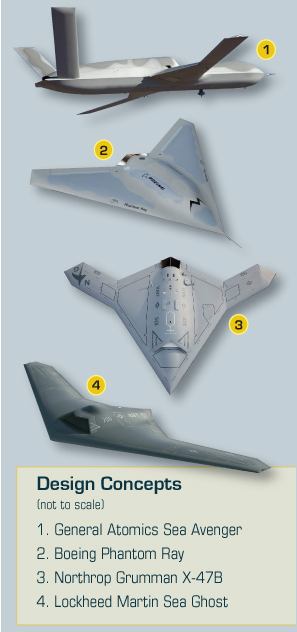
The four candidate designs considered for UCLASS depicted in this image published by the US Naval Institute (USNI)
Future drone attacks could be more pervasive and less constrained by access permissions and host country support, once the US Navy goal to integrate unmanned systems capabilities on board its aircraft carriers is fulfilled. Current operations, conducted by the CIA and Air Force from land-based sites are constrained to the availability, permission and security provided by host nations, bases that should be located relatively close to the target and, hence, may compromise operational security and operator safety. New generations of drones to be operated by the US Navy from aircraft carriers could introduce a new capability, unbound by those restrictions.
Following a year-long delay the U.S. Navy released a draft request for proposal (RFP) for the Unmanned Carrier Launched Airborne Surveillance and Strike (UCLASS) aircraft on April 17, 2014. The draft release was delayed due to disagreements within the Navy, about the technical specifications for the future unmanned aircraft. The final RFP is expected later this year. The new carrier-operated drone is scheduled to enter service in the early 2021.
Four prime contractors are participating in the competition –General Atomics Aeronautical Systems Inc, BoeingLockheed Martin and Northrop Grumman. All four have already been contracted to carry out preliminary studies of a UCLASS type drone and are likely to submit their proposals for the final design. The current draft RFP calls bidders to submit proposals for design, development, assembly, delivery, testing and integration of the air vehicles segment of the UCLASS system. Other elements are likely to include sensors, datalinks, command and control systems.
The US Navy made history last year when the X-47B became the first unmanned air vehicle to launch off the CVN-77 George W. Bush aircraft carrier’s catapult and perform an arresting gear landing. In those cases the X-47B was alone on the carrier. Moving forward, the Navy plans to continue testing the unmanned drone operating as part of a carrier air group. These flights are scheduled to take place in the Atlantic Ocean this summer, aboard the USS Theodore Roosevelt (CVN-71).
UCLASS will be a key Intelligence, Surveillance and Reconnaissance (ISR) asset for future carrier air groups, enabling each carrier of the CVN-78 Ford class to support two continuous ISR orbits at “tactically significant ranges” over uncontested airspace.
In preparation for these flights an X-47B carried out its first night flight at Naval Air Station Patuxent River, Md. The flights planned for this summer will be carefully scripted to measure and account for any variables. The Navy will initially focus on low-tempo operations but could sometime in 2015 intensify the tempo if there is funding and an available aircraft carrier. Aircraft carrier are normally operating on operational cycles of 12 hours each, and all future unmanned assets would be required to align to these operational tempo.
The UCLASS will benefit from lessons learned through these evaluations. According to Rear Adm. Mat Winter, NAVAIR’s program executive officer for unmanned aviation and strike weapons, UCLASS will be a key Intelligence, Surveillance and Reconnaissance (ISR) asset for future carrier air groups, enabling each carrier of the CVN-78 Ford class to support two continuous ISR orbits at “tactically significant ranges” over uncontested airspace. The aircraft would have some stealth capabilities to enable it to operate in ‘lightly contested’ areas.
The Navy has budgeted the UCLASS capability at a $150 million per orbit. Assuming that two air vehicles can cover one orbit (if that aircraft is capable of flying for 14 hours), that means the maximum price point for a UCLASS air vehicle is about $75 million, USNI said, quoting industry sources. According to preliminary specifications released in June 2013 the goal for UCLASS was to conduct two unrefueled orbits at 600 nautical miles (1,111 km) or one unrefueled orbit at 1,200 nautical miles (2,222 km).
UCLASS drones will also have moderate stealth characteristics and internal payload carrying capacity to conduct light strike missions to eliminate targets of opportunity. Additional roles for the UCLASS could also be aerial refueling, albeit, given their limited payload capacity, such missions could be relevant primarily for other UAS.
The original spec called for a minimum payload capacity of 3,000-pound (1,360 kg), to include electro-optic/infrared (EO/IR) surveillance and signals intelligence capability similar to the current MQ-1 Predator and MQ-9B Reaper. The Navy would also like to have a modular radar payload to include synthetic aperture radar and moving target indicator (SAR/GMTI) as well as maritime area search radar capability. In addition, the aircraft will be able to carry 1,000 lbs (454 kg) of external load, primarily weapons.
An X-47B Unmanned Combat Air System (UCAS) demonstrator prepares to launch from the flight deck of the aircraft carrier USS George H.W. Bush (CVN 77). George H.W. Bush was the first aircraft carrier to successfully catapult launch an unmanned aircraft from its flight deck. (U.S. Navy photo by Brian Read Castillo)
An X-47B Unmanned Combat Air System (UCAS) demonstrator is towed into the hangar bay of the aircraft carrier USS George H.W. Bush (CVN 77). (U.S. Navy photo by Timothy Walter)
Part of the Demonstrator Unmanned Combat Air System - Demonstrator (UCAS-D) testing was to demonstrate how an unmanned aircraft can operate within the crowded and complex carrier environment. In this photo the Northrop Grumman X-47B is seen towed into the hangar bay on board the aircraft carrier USS George H.W. Bush (CVN 77) which was one of three carriers that participated in the evaluation. Key design parameters of the UCLASS program will be based on the lessons learned through the UCAS-D evaluations. (U.S. Navy photo by Timothy Walter)
»»  READMORE...